Wednesday, October 15, 2014

The Great Unwinding: A Meditation on Near Unemployment and Life Changes

Middle class middle aged
Middle of the road
Mister wonder what they did
To you

All right. Hey. Way to start off a rambling, introspective piece about near unemployment and life changes, quoting your own sophomoric 20 year old song, written when you thought you were middle aged but were clearly still just a kid. My head must be in darker places than I thought. 

Let me try this again.

"I am the last of a dying breed," he intones with the gravitas of John Hillerman. (That's the guy from Magnum PI. The one with the mustache. No, the other one with the mustache. The short one. The one who didn't drive the Ferrari. In fact, it was really quite rude of you to not recognize Mr. Hillerman and interrupt the flow. In fact, fuck you.) 

(Despite your obvious rudeness, Mr. Hillerman has consented to continue.

"I am the passenger pigeon."

No, that’s too easy. 

"I am the dusky seaside sparrow." (Thanks to my friend Oen Kennedy for that reference.) Better. 

Or let's call Captain Obvious. "I am the dinosaur." Yeah, that’s good, as it aptly connotes my atrophied desiccated software engineering skills. Plus, if someone says "run it down for me from the top," I can say "well, first, the Earth cooled. Then the dinosaurs came, but they got too big and fat, so they all died and turned into oil." (Sorry. When in doubt, quote Stephen Stucker from Airplane. And Leon’s getting larger…)

Oh, hell, let's just cut to the meat of it and use the dodo. Because some days, that’s how I feel. Not only extinct, but so slow moving that the extinction was as plainly predictable as a tornado tearing through a trailer park in Tulsa. And with a stupid name. Kind of ugly, too. Yeah, dodo's good.

In 1984, when Maire Anne and I moved back from Austin and got married, I needed a job. Much of the software engineering work at the time was strategic defense related (what was then quaintly called “Star Wars”), and I didn’t want to do that. Back when people advertised for workers in the newspaper, I answered an ad in The Boston Globe for an interesting sounding position having to do with detection of unexploded ordnance (dud bombs) on formerly-used military properties. The Newton-based company was small and privately held. The commute from my mother’s house where Maire Anne and I were living in Brighton was only about 5 ½ miles. I was interviewed at 7pm on a Friday evening by two guys, one of whom is my good friend Jon with whom Maire Anne and I have been in and out of bands ever since. I was the only one wearing a coat and tie. They offered me a beer. I declined. About ten minutes later, I reversed that overly conservative decision.

Nearly 30 years later, it is the job I still have. Over the years, I went from being one of a staff of software engineers, to senior software engineer, to systems engineer, to project manager, to program manager. I’d identify the opportunity, market the customer, write the proposal, manage all technical and financial aspects of the project, write much of the software myself, go into the field with the equipment, acquire the data, process the data, and write the final report. Jack of all trades, master of none.

Then, in 2005, the company, which had grown from start-up to attractive takeover target, was bought by a ginormous $11b/year corporation.  It wasn’t all bad – they took us on with our seniority, so I was still accruing 4 weeks vacation a year, and they largely left me alone as long as I was winning contracts. I don’t want to badmouth a company for whom I still technically work (more on that in a moment), but the transition from a privately-held company where loyalty was highly valued (many people working for privately-held companies say “it’s a dysfunctional family but it’s our family”) to a publicly traded company where everything is sacrificed at the altar of shareholder value has been an education. Actually, let me rephrase that – in a publically traded corporation, everything is sacrificed at the altar of a group of people’s perception of shareholder value. That’s a very different thing. But I digress.

I was, as many professionals are, a workaholic. Dedicated. Driven. All that preparation. All that tweaking. All that travel. All that modifying equipment to do what I and I alone understood needed to be done. All that data processing in the hotel room until my eyeballs bled and my consciousness wavered like a top running out of angular momentum. All that software written out of thin air to make something that didn’t work as advertised bend to my iron will. All that proposal writing while on vacation. And always available. Hyper-responsive to every e-mail and phone call.

And then, about three years ago, it all started to go away. My proposal hit rate dropped as the funding agency’s priorities changed. Plus, you no longer need someone with my expertise to do a geophysical survey for ordnance; it’s closer to plug-and-play with commercially-available hardware and software.

When this first jolt hit, I was positively apoplectic with stress, as two of my kids were still in college. I did what engineers do: I looked at data. I made a spreadsheet of all of our assets – equity in the house, 401k, mutual funds, cash, cars, and guitars – and groked the number. It was a good number. It was a stress-reducing number. My mother and sister still own the house in Brighton where Maire Anne and I lived for nine years. I thought, what’s the absolute worst that could happen? I never work again. We sell the house in Newton, cash out a boatload of equity, and move back into the third floor of my mother’s house. We’d be in a situation many American families would kill for. And “I’ll never work again” is overly melodramatic. It’s more a question of to what degree I can preserve my inflated salary. I have other income from writing. And Maire Anne works. We’ll be okay, I thought. I not only thought -- I believed. I had data. 

So, as my rational mind said as it strong-armed my lizard brain, what the fuck are you afraid of?

And right then and there, just like that, I looked the beast in the face, and let go of the fear. As Oat Willie says, onward, through the fog.

I developed a strategic plan: Stay at the company, take whatever portion of my salary was available for as long as I possibly could, and ride that ship all the way down into the water. Because once I left, I would likely never see this salary again. Plus, if they laid me off, I might get some small severance package. Besides, I assured myself I’d be smart enough to see it coming and plan my exit, paving the way with a networked path of resumes.

Fortunately, although my projects dried up, there was some amount of related work within the company. Although I wasn’t in control – I wasn’t the project manager – I was glad for the chargeable work, and executed it with the same professional zeal as I did for my own projects.  The work was episodic. When I didn’t have enough to cover myself, I’d either charge vacation or Leave of Absence Without Pay (LOWP), with a commensurate decrease in my paycheck.

But the gaps in coverage turned out to be a godsend, because without them, I never would’ve gotten my book Memoirs of a Hack Mechanic written.

Through 2013, I averaged about four chargeable work days a week. But as we came into 2014, available chargeable time dropped precipitously. There was no memo that said “okay, we only have three days a week for you... nope, two... whoops, sorry, one." It was always on the basis of short-term project needs. But counting up the hours on the pay stubs from 2014, I’ve averaged only 12 chargeable hours a week this year.

Now, at a professional engineer’s income, even partial salary ain’t chump change. At three days a week, the family was still financially comfortable, and I was still able to indulge my extended adolescence and buy cars and whatever parts they required. At two days a week, there seemed to be rough financial equilibrium if I wasn’t spending too heavily on a project. But at one day a week, there is a net outflow of money from the family. We began to hit savings. To offset this, I begin to fix other people’s BMW 2002s for money, despite five chapters in my own book titled “Why I Don’t Work On Other People’s Cars (parts 1 through 5).”

And then Aaron went back to college (he said with aplomb similar to the statement “the H-bomb produced a bigger fireball than the A-bomb”).

Even with this massive reduction in hours, I was still regarding the job professionally – carrying the Blackberry and being hyper-responsive to every e-mail and phone call. To be clear, I’m neither a saint nor a hayseed that fell off the back of the turnip truck. Even when I'm only working a day or two a week, the company has continued to provide me my benefit package, including health insurance. We’ve both had a vested interest in having this continue. With the advent of ObamaCare, this isn’t the unique lifeline it used to be, but I’d be an idiot to dismiss the value of paid health care.

And then… my chargeable work dropped from one day a week to zero. I charged my remaining vacation time, but working only a day a week, you don’t accrue much. At some point in mid-September, after nearly 30 years, I stopped earning any money from the company (though they’re still paying my benefits, I assume because they understand my indispensability for one remaining geophysical survey).

Boy, I’m here to tell you, there’s nothing to cure you of your 30 year workaholic tendencies like ceasing to pay you.

And then… the remaining survey was rescheduled. Again. For November. No, January. Wait. No. November. Maybe. No promises.

Zero work. Zero income. For an indeterminate amount of time. The plan may have been to ride the ship all the way down into the water, but the waves are a-lappin' at the gunnels.

So much for being able to see the end coming and fine-tune my departure with the timing of Joseph P. Kennedy getting out of the stock market.

I haven’t been the proverbial frog in the water whose temperature is being slowly turned up and he doesn't know to jump out. I’ve been a fish in a bowl whose water has been slowly removed, and now it’s gone, and I wonder why I can’t breathe.

The funny thing is that, in a few weeks, I'll reach my actual 30th anniversary in this position. I want to call up Alanis Morisette and say "this is ironic. Rain on your wedding day -- that's just bad luck." And if someone I don't know shows up at my house with a 30 year plaque and one of those sheet cakes from Shaws and says "the company wants to thank you for your service," I swear I won't be responsible for my actions.

There’s old-school advice from your father’s era about having six months salary in the bank for your “gentleman, I resign fund.” That way, when you’re at the big meeting, and it’s not going the way you like, you can push your chair back from the table, slowly and dramatically stand up, say “gentleman, I resign,” and walk away from the table, leaving a concerned mumbling mass of men in blue seersucker suits to clean up the wreckage in the aftermath of their bad management that resulted in your highly ethical though slightly smug departure.

As much as I would like to do this, I can’t, because:
1) Everyone I worked with has left,
2) I attend no big meetings (when I work, I work from home), and
3) I don’t have a table.

If this final survey is indeed rescheduled for early November, I can fart around with cars for a few weeks, then do the survey, get the last of my full 40 hours a week salary for a couple of weeks, and then, to use that time-worn aphorism that’s no longer cute for a 56 year old, decide what I want to be when I grow up.

Like that’ll ever happen.

But wait. Into this mix steps someone I know from the automotive world who offers me a job. It’s not close to my full engineering salary, but at 12 hours a week, I haven’t been making close to my full engineering salary; it’s a damned sight better than I’ve been getting. It’s a chance to be a Full Time Car Guy, which clearly deserves case capitalization. 

So it’s all good. I’m fine. Really.

Except that I feel like I’m a watch spring that’s been in a period of slow unwinding. Before it gets wound back up again.

And so, I look back at the past year, where my pay stubs tell me I’ve averaged only 12 hours a week. And it’s gotten me thinking…

WHAT THE HELL HAVE I BEEN DOING WITH ALL THIS TIME?

Oh. Writing my book. Right.

That would make me feel better. If it was true. Unfortunately, it’s not. The book was published last year, not this year.

My mother tells me that, when my grandfather retired, my grandmother told him “I married you for better or worse, but not for lunch.” Maire Anne, however, has assured me she likes having me around (since I’d been working from home, I’ve been around anyway). But there are only so many sleep-late mornings and long showers one can take. There are only so many times I can convince Maire Anne to come back to bed with me. She loves it when I come to Costco with her, but… really, what did I do with all this free time?

I can certainly point to isolated things. I rebuilt the engine in my ’72 2002tii and drove it to a 2002 event in Arkansas and back. I bought a ‘72 Bavaria, got it running, and drove it to an event in Winston-Salem and back. I covered SharkFest for Bimmer Magazine, flying down and writing the article. I did a whole variety of mechanical projects on my other cars. (No, I haven't done anything with the Lotus. Don't talk to me about the Lotus. The Lotus is going to be the death of me.) I've banged out my bi-monthly Road & Track article, my bi-monthly Roundel column, and my weekly Roundel Online piece. And, yes, I worked on other people’s cars for money. So I did stuff. Lots of stuff. Honestly, I'm not sure why I'm defensive about it. But, still, it’s hard to see where all the time went.

My best conclusion is that if I averaged 12 hours a week working, I spent perhaps eight hours a week working on cars, ten hours incessantly searching Craigslist, and the other ten on Facebook. I joke, but that’s not far from the truth. I can easily blow half the day on Searchtempest following fantasies of buying a 2002 on the other side of the country and nursing it home, then posting candidate cars on Facebook and delighting in the fact that people I’ve never met are offering to ride shotgun or put me up and ply me with craft beer if I come through Akron. Seriously, I should put together an article where I do a road trip consisting of nothing but taking up all these lovely people on their offers.

In reaction to the forces buffeting me about, I did the only rational thing a man can do. I bought a trove of new and used vintage BMW parts from a closing restoration shop. Two full Suburbans worth. 12 bumpers, five fenders, two noses, grilles, tail lights, more. A few small high-value pieces sold quickly, allowing me to more than cover my costs, but the rest has been an enormous time sink of dubious value. So why did I do it? In the end, it was obvious that it was a wonderful, glorious, classic, crystal-clear case of displacement behavior -- doing this instead of dealing with larger issues. I felt that I had little control over my employment or my future, but I could decide which parts I put on eBay and how I packed and shipped everything. It was oddly soothing.

There are many days when I try and keep my options open, waiting for possibilities to unfold a certain way. No sense in driving into Boston to pick up parts at Herb Chambers if that guy in Worcester is going to call me about those Recaros, right? Just trying to be efficient with, uh, all this time. While I’m waiting, maybe I’ll check Craigslist in Tampa one more time for that elusive ’63 Rambler. After all, my friend Al lives there; I could crash on his sofa while I sort out the vacuum-actuated windshield wipers. Makes sense, right?

I realize that this is a glaringly obvious microcosm of a larger issue. My ex-colleague Roy tells me that, when we worked together, I had this tendency to want to keep all options open, or as many open for as long as possible. Professionally, I got a lot of mileage out of this. Who wouldn't want options? But Roy got me to see that, in fact, after a certain point, it became a problem. Options have to function correctly for them to be viable. And they have a cost in terms of operation and maintenance. At some point, you may need to close some of them off and concentrate on fewer things to make them actually work. And life imitates engineering.

I haven't committed yet to taking the Full Time Car Guy job. What's holding me back? Well, there are logistical issues, transition of health insurance and so forth, and there's the pay cut (which, as I said, is bigger on paper than in reality), but much of it has to do with my hesitancy to close off options in my "I'm not quite dead" engineering job. I realize this is slow death, but I'm finding it difficult to play my "gentleman, I resign" card. In Machiavelli's The Prince, he says "a prince can escape short-term danger through neutrality, but at the cost of long-term grief. Instead, a prince should boldly declare his support for one side." I may be the king of bumpers, but I guess I'm not a prince.

Similarly, there’s the famous story, alternately attributed to Caesar, Tariq, and Cortes, of the general who, upon landing his army in hostile territory, ordered the ships burned to cut off the possibility of retreat and ensure that the only path was forward.

I don’t want to burn the ships. 

But at the same time, I've sailed a long way without a map, and I’m looking back over the wide expanse of ocean I just crossed, and thinking… you know, I’m really not a boat guy. Those waves made me sick. I mean, we evolved lungs and feet to get away from the heaving sea. I’ve landed. Somewhere. This dry land feels secure. You can't beat Terra firma. Yeah. This is good. Let’s walk over the next rise. Wonder where we are?

Oh fuck. This is Mauritius. Where the dodos were all clubbed to death.


(copyright 2014, Rob Siegel, all rights reserved)

Monday, September 1, 2014

The Nantucket Kennedy Bunker


In August, while vacationing on Nantucket, I connected with my junior high school friend Tom Porter. Tom, it turns out, has been coming to Nantucket longer than I have -- his parents owned one house from '63 'till '78, then another house beginning in 1986. I was surprised that, with Maire Anne and I coming down to the island since 1984, I'd never intersected with Tom, but life is full of such near-misses.

Anyway, Tom told me a story I'd never heard -- that, at the Fairgrounds at Tom Nevers, there was a bunker intended to shelter John Kennedy and related family and officials should circumstances have necessitated whisking him out of Hyannisport.

I looked online, and found a handful of references. The Wikipedia page for the Tom Nevers Naval Facility on Nantucket (http://en.wikipedia.org/wiki/Tom_Nevers_Naval_Facility) is quite short, basically just saying that the base was open 1955 through 1976 and was used a submarine listening post. But it does say that the facilities included a bomb shelter for JFK. The page also says that the shelter "later became home to the Nantucket Hunting Association. The shelter still has electricity and can still be used." This Wikipedia page includes a reference that is linked to an article by Steve Sheppard, "The Kennedy Bunker: Hidden History by the Sea" in The Nantucket Independent, an island newspaper. However, The Nantucket Independent is defunct, their web site no longer active, so the link to the reference is broken. I have not been able to locate another source for Mr. Sheppard's piece. I did, however, find numerous references online to another shelter for JFK, on Peanut Island near Palm Beach, FL.

When Maire Anne and I were done packing the truck and heading for the ferry, we had an hour to kill, so we drove down to Tom Nevers to see what we could find. I knew exactly where The Fairgrounds was; it's a field at Tom Nevers, the site of a small annual carnival on Nantucket where, in fact, my favorite picture of Maire Anne and I was taken in 2001 by our friend Kim Cox.


Upon arriving at The Fairgrounds, the bunker was so obvious I was astonished I'd never wondered what it was before. The pic below shows the flagpole that was probably associated with the Naval facility. The bunker is the mound in the background. The "sharks fin" is a tree on the mound.


There used to be more old naval base buildings left at the former Tom Nevers site, but the south side of the island is prone to heavy erosion, as shown in the photo below; the bluff under the roadway has eroded over the years, taking the road and probably buildings along with it.


As you approach the bunker, there's no plaque or anything indicating its historical significance -- just a large rock denoting that this is the Faigrounds location. But there's no missing it.


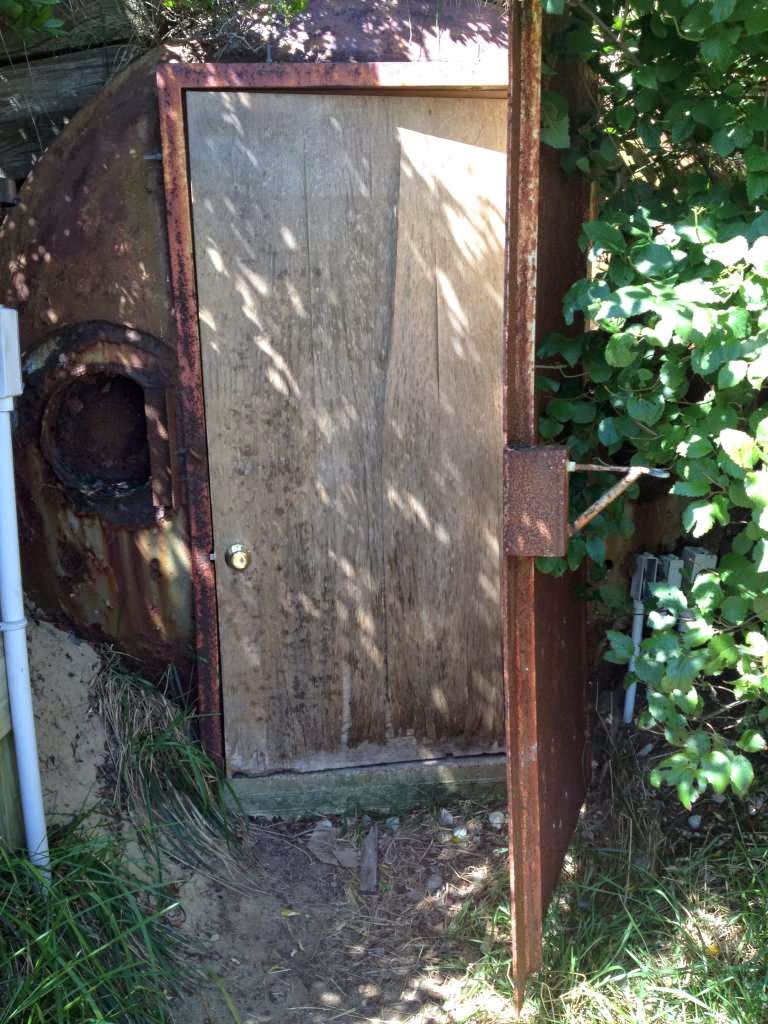
To the right of the rock, there is what is clearly an entrance to the bunker with a big old rusted steel door.


Maire Anne said "is the door unlocked?" Yeah, right, I thought. But when we looked at it,we saw no big padlock or chain.


I gave it a tug, and it swung right open and revealed...


...another door!


Maire Anne said, again, "is it locked?" I felt like I was in an old Carol Burnett episode. Amazingly, this door was unlocked as well. I opened it carefully, remembering quite acutely the time that a colleague of mine and I cracked open the door to a long-abandoned structure during a geophysical survey and were greeted by wasps. We opened the door to see... this. You can't tell from the pic, but the large corrugated metal tube is horizontal. That is, it goes straight into the mound, not down at an angle. Not a subterranean bunker, you understand; "bomb shelter" is probably the better word.


Wow, we both thought... this must be the place. What else could it be? Should we go in? Is this even legal? Curiosity is a powerful drug. With iPhone flashlight at the ready, in I went. Below is me looking back at Maire Anne, begging her not to lock me in. Hey, we've been married 30 years and love each other deeply, but you never know when someone harbors a grudge.


My iPhone flashlight was laughably inadequate, and when I tried to take pics, of course the flashlight cut out, and I was left standing in pitch blackness, fumbling to turn the flashlight app back on. But it clearly appeared that the bunker was made from intersecting corrugated metal tubular Quonset structures. Below are some absolutely awful photos:


Maire Anne came in and joined me, but with inadequate flashlights, and images of Island kids bragging "yeah, we locked ANOTHER pair of tourists inside, weren't they FUNNY when they SCREAMED," we didn't stay longer than a minute.

Then we climbed up on top of the bunker. Below are some pics from the top of the mound, showing the fairgrounds, playground and ballfield, and the gorgeous southern Nantucket coastline.


After we got back home, I searched again online for info on the Nantucket Kennedy Bunker. This time, I found this site, which misrepresents the location as Cuttyhunk Island, but clearly is the same facility. In the photos on this site, the lights are on, the facility is clean and well-lit, and you can clearly see what's murky and ill-illuminated in my bad cell phone pics.


I also found this piece in the New York Times. It is predominantly about the Peanut Island bunker (calling it "the worst-kept secret in Palm Beach"), but mentions the Nantucket bunker. Interestingly, it says that the site "has never been open to the public" -- ironic considering how "open" we found it.


Maire Anne and I wondered... was it by accident that it was open? Was it supposed to be locked but was recently broken into? Or is it such old news among island residents that the town feels the liability issues are of little concern? I'm curious about these things, and will make a few calls to the Town of Nantucket and the Nantucket Historical Society to find out.

I'm glad Maire Anne and I chose to spend our hour before the ferry departed in this way. Yes, we could have spent the hour a different way -- you know, joined the "bunker club" -- but, you know, after 30 years of marriage, the lure of comfort and clean sheets is pretty strong.

Besides, now we know what to bring next year. And, yes, the parallels are obvious, but only up to a point. I mean, I share JFK's appetites, but I'm a one-woman man. But if the world is ending, now we know where to go.

Or come.

:^)

(copyright 2014, Rob Siegel. all rights reserved.)

Sunday, August 11, 2013

Yellow Car! Meditations on the Value of Competitiveness

Maire Anne and I have been coming to Nantucket for nearly 30 years. Our kids have Nantucket vacation memories woven into the fabric of their lives. About 12 years ago my brother-in-law Dan and my nieces Aidan and Guthrie began joining us. This has been a gift, as it has provided an opportunity for Maire Anne to spend time with her brother (who has evolved into my fishing buddy), and for my boys to spend time with their cousins.

And for me to enjoy my nieces Aidan and Guthrie, both of whom I absolutely adore. In the chapter in my book titled "The Bluefish Races (or, wanna drive?)" I talk about the family tradition of using Nantucket's vehicularly-accessible beaches to give my kids, and my nieces, their first driving lesson. This has been a particularly special thing with Guthrie, who is the sort of kid who knew, to the day, when she was eligible for her permit and license, and bugged her parents until she had the paper.

Driving on the beach was less important to Aidan, but the two of us have had other traditions, and some of them have brought out a competitive streak in both of us. This is a surprise to me. I'm not by nature a competitive person. Most of the time I could give a shit about sports (I'm certain I'm the only person in New England who felt a certain perverse satisfaction when the Patriots lost the superbowl at the end of their otherwise perfect season). I remember doing a team-building exercise at work many years ago where everyone had to write down their personal values, then work together to come up with group values. My boss wrote "winning" as his #1 personal value. I thought, that one isn't even in my vocabulary, much less on my list, much less the topper of that list. And Aidan is a whip-smart Mount Holyoke student, laser-focused on certain key interests. I hadn't expected her personality to manifest itself in a stridently competitive way (although I suppose her presence on the fencing team might have tipped me off).

Although Aidan hasn't participated in the informal competition for our annual family Fish Trophy, for several years we've competed in other ways. For a while, during both vacation and Thanksgiving visits, we played Trivial Pursuits -- The Lord of the Rings Edition. It was here that I first saw the fierce take-no-prisoners nature of her competitive streak. I drew the question "What language did the Riders of Rohan speak?" I answered "Ronic." The card said "Rohirric." She wouldn't give it to me, even though she was totally and completely mopping the floor with me, game after game. Of course, this set the bar for subsequent TP disputes. After that, I didn't give her an inch. And she still clobbered me.

This vacation, Aidan introduced us to the game "Yellow Car." She explained that, originating in the British radio sitcom "Cabin Pressure," the game is elegant in its simplicity. It has but a single rule -- when you see a yellow car, you yell "yellow car!" As we began to play, we learned that, in fact, there is a second rule: Taxis don't count (this because, on the show, the character Arthur Shappey blurts out "yellow car!" every two seconds when he sees the surfeit of taxi cabs in London, so his brothers impose this rule to get him to shut up). A vacation guest of ours saw a school bus and yelled "yellow car!" Aidan said "school buses don't count -- only cars." Then the same question came up regarding a yellow van. I pointed out that most yellow cars we'd seen on Nantucket were a Jeep or other sport utility vehicle, and that these are classified as light trucks, thus technically not cars. She grudgingly let the point go.

But for the rest of vacation, she was relentless in being the first to yell "yellow car!" whenever we were driving somewhere and encountered a yellow car.

So I, of course, stepped up to the challenge. Game on, MoHo girl. Whenever I saw a yellow car and called it before she did, she said "damn it!" She contended that I had the advantage because I, the driver, could see out the front window better than she could being a passenger in the back seat. I said that, no, in fact, as a passenger she had the advantage because she could look down driveways and in parking lots, which she did with cruise missile-like targeting, including remembering specific locations where specific yellow cars were parked (I will admit that I began doing this as well).

Finally, as Dan and the girls' vacation stay was nearing an end, we drove them to the ferry. As we wended our way through Nantucket center and were about to turn onto the street leading to the Steamship Authority terminal, I spied a yellow car and said, with a certain aplomb, "yellow car, and oh, by the way, probably the LAST yellow car we'll see before the ferry." I smiled, thinking that I had gotten her.

This, of course, elicited a stiff "damn it!" from Aidan. She then went into full-on focused Terminator mode, feverishly scanning in all directions as we drove the last few hundred feet into the ferry parking lot. 

Then, with some degree of triumphalism, she yelled "YELLOW CAR!" Sure enough, there in the ferry parking lot was a lone yellow car. She smiled triumphantly. Oh well, I thought, too bad. 

But it ain't over 'till the fat ferry sings.

As they loaded their luggage onto the cart, and we hugged goodbye, and they began to walk toward the gang plank to take them up onto the ferry, I looked back in the direction of Nantucket center. There, perhaps a hundred yards up the street, could it be? Yes! I said slowly and loudly "Yellow. Car. BOOM!" and pointed up the street. It was a ways away, but it was unmistakable. It elicited a final "damn it!" from Aidan, indicating that it was unarguable. If I had a microphone, I would've dropped it and engendered the loud DOOF and feedback squeal, as comedian Chris Rock sometimes does at the end of an in-your-face performance.

I can't say Aidan was crestfallen, or furious. That would be an exaggeration. It is only a game. But she was NOT pleased. My family gave me grief. "How could you have taken that away from her?" they asked.

I've thought about this for a few days. I don't think I "took anything away" from my dear niece. I think I added to our relationship. This is playful, constructive interaction. I fully expect Aidan and I to begin texting each other pictures of yellow cars.

But is this a window into a higher value for competitiveness? I'm not sure I'd go that far.

That having been said, I must admit that my final, door-closing, game-ending, microphone-dropping, soul-crushing "yellow car" was a thing of beauty. Like the Star Trek Next Generation episode where Data has to admit that he enjoyed killing the Borg, I need to admit that, despite my Zen self-image, I apparently do have a competitive streak.

Or maybe it's just that my brilliant quirky niece brings the worst in me.

So. Go ahead. Introduce "yellow car" to your family. See who plays. See what it brings out. But be prepared to bring your A-game. Take no prisoners. Expect no quarter. For none will be given.

Saturday, June 8, 2013

Thoughts on Overhaulin’ the Europa

I have made it known, both in my book and in presentations I give at events, that I have a jones to own a Lotus Europa twin cam. They weight just 1600 lbs, are only 42 inches high, look like nothing else on the road, and are currently undervalued because those looks are so extreme that they’re often referred to derisively as a “bread van.” My friend Alex said “I always they thought they looked like a Ranchero.” Ouch.

Having nothing to do with Europas, in my book I am a bit hard on the cable show Overhaulin’. To those unfamiliar with Overhaulin’, they take a beat-to-shit car that someone loves, work with their spouse or significant other, abscond with the car on the ruse it’s been stolen, then resurrect it. Automotive customizer par excellence Chip Foose is with the show, and there’s no denying that he and his crew do incredible work. The cars are rebuilt from the ground up, usually with heavy customization – updated high-output engine, massive wheels and low profile tires, leather-stitched dashboard, killer sound system, etc. They do all this in a hugely compressed time frame with a hard end date (“the reveal”). They then present the car to the owner, who is filmed overcome with tears of joy.

While I’m certain that all of the people working on the cars (and on the show), take pride in what they do, I have problems with it on several levels. First, no restoration work – indeed, no project management work of any kind – is like this, ever. You never are part of a project with boundless scope and an immovable end date where you have absolutely no skin in the game. Second, a car, particularly an enthusiast car, is a very personal thing, and, as I say in the book, owning an enthusiast car is very much about the feeling of control. I wouldn’t want any of my cars taken out of my control and modified in ways I hadn’t explicitly approved of. Third, they never talk about the after-care of these cars. I doubt the pre-overhauled shitbox required high insurance and a locked garage, but the Cinderella version certainly does. And it’s a one-off. Who maintains it? Who documents, orders, and installs the necessary parts? I’ve always felt that “Overhaulin’ – Behind the Alcantra” would be a very interesting show.

So I took notice when two friends sent me e-mail referring to a recent episode of Overhaulin’ where they do a Europa. One said the treatment they gave it was pretty cool, and implied that if I watched it, I might soften the opinion expressed in my book. I’m actually inching closer to perhaps buying a Europa, so with a certain curiosity and enlightened self-interest, I found and Tivo’d the episode, and last night, sat down to watch it.

The episode was a bit unusual in several ways. The guy who’s Europa it was delivers soda to Jay Leno’s Big Dog Garage where Jay maintains his cars. The guy volunteers his time there after hours as a wrench. So Jay Leno – the car guy’s Car Guy – was involved in this episode and had a lot of screen time. The guy had owned and raced this Europa over a 30-year period but blew up the engine about six years ago. The car was then parked at the Big Dog Garage, where it sat. He eventually traded it to someone at the garage for a set of wheels for his Camaro. So at the time of the episode, the guy no longer owned the car.

The Overhaul treatment the car received was over the top. A 350 hp supercharged engine from a Lotus Elise and a Porsche Boxster 6-speed transaxle were installed. The obligatory massive wheels and tires were stuffed under the wheel wells, requiring the fiberglass body to be cut and widened around the fenders. A full custom suspension was designed and installed, requiring the mounting points on the car’s frame to be changed. The usual retinue of body workers, painters, interior specialists, all did their thing.

At the end, with the paint literally still tacky on the car, the guy was called in on the pretense of a TV segment on Lotus being filmed, his role being an enthusiast who had once owned and raced a Europa. First they revealed that this tricked-to-the-max machine was the very Europa that was once his, then Leno and Foose appeared and gave him the keys. So, in ways, this reveal had three components: 1) This is the Europa that was yours; 2) Look at what we did to it, and 3) It’s yours again. His response certainly contained the customary surprise and gratitude, but seemed to me to be somewhat measured. That is, he was surprised that this was the same car and grateful for all the work that’d been done on his behalf, but he didn’t express any over-the-top sentiments like “oh, this was the best car I’d ever owned it was part of my life for so long I never should’ve sold it thank you for rectifying this mistake.”

But that’s not what wrapped this episode up with an unintended bow.

If you read up on Europas, you’ll find that the generally small size of any British sports car combined with the Europa’s 42” ground-to-roofline dimension makes them challenging to fit into unless you’re a little guy (see the banter on http://bringatrailer.com/2013/02/23/1972-lotus-europa-twin-cam/ regarding a Europa I almost bid on several months back). Fortunately, I am a little guy.

But this guy on Overhaulin? Taller and probably a good 40 lbs heavier than me. At the end of the episode, he could barely fit in the car. They literally joked about getting a transmission jack to help him in.

It made me think. Of course he’s a bit restrained in his reaction to the car. He sold this car. No. Wait. He didn’t. He traded this car for a set of wheels for his Camaro. Maybe he was done with this car. Maybe he thought, yeah, at this point in my life I’m totally a Camaro guy. Maybe he walked away from the reveal thinking “what I am I supposed to do with this thing now?

So, Mr. Leno, Mr. Foose, you are Car Guys Extraordinaire. If we ever meet, I would be honored to soak in your aura. But, if you read my book, don’t mistake the misty rose-colored comments I made about my Triumph GT6+ and my ’63 Rambler Classic 660 for actual actionable lust. I don’t really want either of them back.


Wednesday, June 5, 2013

Apparently, People Like My Book

So much has happened...

“Memoirs of a Hack Mechanic reminds me of summertime Saturdays when I was a boy and Dad and his buddies would park their rides — Mercs, Caddys, Chevys — in our broad dirt dooryard and make out with them. It was a wrench-twisting ardor full of grunts, cursing and the sizzle of beer bottles bursting open. Rob Siegel, a writer with permanent grease under his nails, would’ve totally been into it. And this funny, frisky book tells why.”


“Rob Siegel, a Newton resident, has produced one of the best auto memoirs I’ve read in a long time."


“This book is written by a car guy for car guys about car guy experiences. It is part autobiography, part encyclopedia, and part advice column. It is chocked full of useful hints about everything from acquiring a car, repairing a car, and even when the sad event is necessary, disposing of a car. It is a lifetime of experience hard-won and passed on gladly.”


“Rob Siegel writes observations on the Life Automotive that are centered on both his personal quest towards Wholeness by fixing broken BMWs, telling the world (at least those readers of Roundel) about his journey towards this goal, tossing in what he accurately calls “actual useful stuff” along the way, and comes across as the sort of person who you pray will sit at your table at a dinner because you KNOW you will have a good time. Yes, he is funny in the way that those who never quite grasp the notion that life is supposed to be an A to Z proposition are, and, therefore, approach life on their own terms.


The tone and Zen-seeking flavor makes Memoirs of a Hack Mechanic an easy read that often makes you chuckle (because you've been there) or marvel at the clever solution to a potential landmine of a repair ("cascading failure" is Siegel's apt descriptor). Talking about the process of auto repair not from the "put-tab-B-into-slot-A" perspective, but from the "stand back and look at the big picture" point of view that the book takes is due, in part, to the author's day job as an engineer. It's good advice, and it's why the book has appeal beyond fans of Neue Klasse Roundies.


Jeremy Walton, Automotive Writer: http://www.jwarthog.com/hack-mechanic.html

“Siegel’s expletive-undeleted sense of humour and intelligence rule and I thoroughly enjoyed it. The hard-earned mechanical knowledge shared is worth triple the price of the book, especially that on painting a car and degrees of rust. I think that’s summed up best by this observation: “I think I can safely say that one has ever taken a car in for restoration and been told, ‘You know, that rust isn’t nearly as bad as we thought.’”


“This is a must read for any self professed “car guy.” We're only about half way through it and so far it's fantastic! In Memoirs of a Hack Mechanic, Rob Siegel shares his secrets to buying, fixing, and driving cool cars without risking the kids' tuition money or destroying his marriage.”


“Inspired by John Muir's VW 'Idiot Book' (aren't we all), Rob Siegel spins a fab mix of Zen and 20w50; engine rebuilds in the kitchen, a hated GT6, an obsession with BMW's 2002 (he owned 25!), song-writing, guitars and the meaning of life via a greasy tool kit. The wealth of advice and humorous stories will strike a chord with any classic car nut.”


“Author Rob Siegel from Roundel magazine came to the Vintage with his 1973 3.0CSi. Siegel signed copies of his new book, Memoirs of a Hack Mechanic, and talked about parts of the book that might surprise people. “I have a chapter in the book titled ‘Why Men Love Cars,’ and it offers insight into the mind of a car guy,” Siegel said. “Cars are useful to men as objects of passion in a way that’s difficult for women to understand. But it’s also healthy and constructive in terms of long-term relationships. It’s maintaining passion within a sane set of boundaries.””


Saturday, January 26, 2013

Thoughts on the Move, the Power of Personal Space, and The Importance of a Stupid Acrylic Dolphin

I have not changed jobs in 29 years. I was hired in 1984 by a small engineering firm as a software engineer to do mathematical modeling and software development for unexploded ordnance detection. I became lead software engineer, then lead engineer, then project manager. For a while I was quite successful at writing my own proposals, bidding and winning my own work, leading a team to build the equipment, doing the survey, processing the data, and writing the final report. Then, in 2005, the small company, which had grown to not-so-small over the 21 years, was bought by a ginormous corporation. They closed the Newton office and, due to their own incompetence, moved me and my small group into an oversized 12,500 square feet of warehouse space in Waltham. But I was still writing winning proposals, so it was good. Hell, it was great -- I could buy as many cars as I wanted and the warehouse would swallow them all and still have room to park a tractor-trailer inside. Seriously.

Then, with the downturn in the economy and the cutbacks of government spending, research money for UXO detection became harder to get, and my hit rate in writing winning proposals dropped like a rock. I voluntarily cut myself back to part time to avoid getting laid off. But with fewer billable hours for both me and my group, we weren't generating the overhead necessary to cover the rent on the warehouse. Upon getting back from Dry Prong over Thanksgiving, I learned that a decision had been made to close Waltham and we needed to be out by the end of January. I found industrial space in Woburn that's 1800 square feet. So over the past month we've been preparing to downsize and move to one eighth the square footage.

Along with other things, this means the end of the 4.5-mile-each-way commute I've had for 29 years, and the beginning of a 20-mile-each-way jaunt. But, I thought, I don't need to be up in Woburn every day -- only when I have to work with physical hardware. If I'm just doing computer stuff I can work from home, which I'd occasionally done for years anyway. And, I thought, if I was working from home, I didn't need to move my cubicle to Woburn -- one less thing to move. I could just set up a table when I needed a computer up there.

Going to 1/8 the space isn't as bad as it sounds. The Waltham building was always four times as big as it needed to be, and thus had a lot of empty space, so it's not like we had to put eight pounds of shit in a one pound bag. I donated our ground penetrating radars -- developed for land mine detection applications under contracts that ended in 2001 -- to a colleague at Northeastern University who consulted for us.I threw out a ton of stuff. 

And I left everything else behind for the liquidator. In these moves and closures, an odd sort of economics takes hold. Here we had a large building with electronics, equipment, machine tools, and furniture. We had liquidators come in and bid on it. I thought the company I work for would earn pennies on the dollar for the equipment. Wrong. It COSTS the company money. The liquidator calculates what the leftover equipment is worth (and they've very concerned that you'll cherry-pick before they get it), and subtracts that from the cost of disposing of stuff that isn't worth anything and leaving the building in broom-clean condition. People are often surprised when they hear that when a company closed, everything went in a dumpster. The reaction is "how could they do that? What a waste." But if you think about it, it doesn't make economic sense to pay me my salary to put items up on eBay unless the return is greater than the cost. 

Now, we've all had the experience of organizing things and winding up with odd leftover piles. I have a song about it:

When I organize the office
Or clean out my top drawer
The bills go in the folder
But there's stuff that's hard to sort
Here's some cufflinks from my father
Here's a tape from my old band
Here's a fountain pen from high school
When I used to write longhand

Here's a birthday card from Lisa
Here's my old UMass ID
Here's a clipping from a magazine
That reviewed my CD
These things can't be filed or organized
And can't be thrown away
So I put them in a box
With other stuff that I must save

Irreducible... fragments of a life
Irreducible... it's a wonder what survives
Irreducible... these pieces I can see
Irreducible... must mean something to me

Sometimes I open up these boxes
And let them take me back
I don't clean them out or second-guess
I leave everything intact
As I look across this cluttered house
From the mundane to the grave
I think about these memories
And wonder what to save


Irreducible... fragments of my life
Irreducible... it's a wonder I survived
Irreducible... greater than the whole
Irreducible... breadcrumbs to the soul

Granted, this wasn't my house, but the same dynamic took hold. I can be both entropy in motion as well as meticulously organized, depending on which need is greater. Here, organization was paramount. I dutifully sorted everything in my office and my lab into boxes with labels like long serial cables, short serial cables, RS232 hardware, USB devices, office supplies, etc. 

These days I rely heavily on archived e-mail and don't file many paper documents, but as I found important pieces of paper, I placed them in a manila folder. Then I remembered -- I had a whole file cabinet I hadn't looked at in years. I rifled through it and pulled out a few original documents that existed only in hardcopy, and a folder of personal memos.

In this archaeological dig, as I was able to see the bare surface of my desk, I exposed the personal objects that have been in my office for over 20 years -- photos of the family, a root carved into a fish I bought on the Vineyard when Maire Anne was pregnant with Ethan, a sliding MC Escher puzzle, one of those oil-and-water things that you flip over and watch bubbles bounce down a flight of stairs. I flipped it and watched the bubbles do their little walk. I thought, this is silly, I should just throw these things out already. But I didn't. I put them in a box. With other stuff that I must save.

As this process winds all the way down, the only things the objects have in common is that they have nothing in common. Between the framed photos, keys to locks I'll probably never use, the desk toys, and other last-moment bric-a-brac, I had three boxes labeled "last stuff out of my office."

And then I noticed the knee-high under-desk filing cabinet. I hadn't used it in years. I slid open the top drawer and found mainly the detritus of office living -- tops of pens, staples, paper clips, a pack of PostIt notes, and whatnot. But then I saw two old health care ID cards. I looked at them closely. They had my social security number printed on them. Gee, I thought, good thing I looked. Let me dump everything out and make sure there's nothing else in here that could cause identity theft.

I pulled out the drawer, and there, all the way in the back, was the tackiest vacation trinket you've ever seen. It was a pen holder in the shape of a flat acrylic dolphin, clear but with beach sand and small shells embedded in it. It said "Greetings from Jamaica." My son Kyle brought it home for me when he went there with my mother.

I instantly burst into tears.

I placed it in the last "last stuff out of my office" box, and filed away this utterly surprising reaction for later analysis. (Yeah. I know. Mister left-brained engineer has a bolt-from-the-clouds right-brained emotive experience, and "files it away for later analysis." Don't you just want to slap me? I do. Sometimes I think a good hemorrhage would do me wonders.)

The absolute last thing out of my office was my computer, a heavy engineering-sized desktop with a big monitor. Decision time -- where would this computer go? That question is subservient to this one: Where would I set up my office? I'd already decided that would be at home, right? I thought, well, I have my personal notebook PC, I have my work notebook PC which I always bring home with me, and now there's this big desktop. What, am I going to put all three of these on the dining room table? Makes no sense, right? Right. The big computer goes to Woburn. Thus, my "office" goes to Woburn. But I'd already made the decision to leave my cubicle behind. Again, I thought, no problem, I just need a table. I'm an engineer. I'm a functional guy. Just need a surface.

The space we're moving into has about 1500 sqf on the first floor that we're setting up as storage, machine shop, and dirty assembly area, and about 350 sqf on the second floor designated to be a clean assembly area. The move was like a tidal wave, with me in Waltham directing the outgoing trucks, and an employee of mine in Woburn managing the inflow. I didn't plan thoroughly enough, and even if I did, stuff doesn't always come in in a useful order. So shelves and cabinets went where they went, and stuff rapidly got unloaded onto those shelves because it had to go somewhere. When I arrived in Woburn to look at how it had been set up, I couldn't visualize where I, where my office and lab space, would go. Of course, my employee very adroitly set up where his stuff would go -- he's better at that than I am, and he was right there to direct stuff into its resting places.

Over the next day, as I organized Woburn, I still couldn't quite visualize how I would work there. Oh, sure, when I'm fixing equipment or building electronics, there's a bench set up for me, but I was having trouble seeing where I would set up a table for... other work. It took me a while, but I realized the problem.

Cubicles, for all the ridicule they take, do provide an environment. They define a space as yours. They provide vertical surfaces to pin the pics of your family and your "hang in there baby" poster. And even if you don't stick anything on the walls, the walls provide borders for the desk. They allow you to put things on the desk and shove them all the way to the corner and not have them fall off. Things like staplers. Like tape dispensers. Like a root carved into a fish. Like the Escher puzzle. Like the bouncing blue droplets descending a flight of stairs. Like... the dolphin.

I burst into tears again.

I looked at the three boxes labeled "last stuff out of my office," and realized that nothing in them matters a whit, nothing is of any importance whatsoever, but the issue I'm struggling with centers around where the stuff in them should go because that stuff makes a place feel like it's mine. I realized that I was wholly unprepared to relegate these boxes to my basement, or to storage in Woburn, not to be opened again except to reminisce. 

Trying to deconstruct the "office question," I realized that I set events in motion in a way I did not appreciate by not moving a cubicle over to Woburn.

As to why the dolphin in particular has become such a talisman, the simple gift of an eight year old to his father, politely received upon giving, dutifully taken into work and put on the desk, lost, utterly forgotten without a second thought, unearthed from the back of the top drawer of a file cabinet, now seems to be imbued with deep magic from before the dawn of time. It has become precious to me. I start to cry whenever I think about it. It has become...

Rosebud.


Saturday, January 19, 2013

Hack Mechanic Memoir Status


Hi everyone. If it's not too shameless a self-promotion, I wanted to provide an update on the status of the book. Bentley Publishers is very close to having a publication date and the ability to pre-order. They've set up a Facebook page for the book where you can "like" The Hack Mechanic and check on the publication date and my speaking schedule. The FB link is:

http://www.facebook.com/MemoirsOfAHackMechanicByRobSiegel

For these early speaking engagements, since the book isn't out yet, Bentley is setting up a system where, if you come hear me speak, and take a photo of the two of us and post it to the FB page, and then order the book from the Bentley web site, Bentley will cross-reference the pic with your order and have me sign your copy before it goes out.

Thanks!

--Rob