On Saturday 7/14/2012 I announced the following:
It is with joy bordering on the profane that I announce that Bentley Publishers, publishers of the best damn automotive repair manuals in the world, has signed me to publish my 350 page book, tentatively titled "Car Nut: Why men love cars, and how fixing BMWs saved my sanity (a memoir with actual useful stuff)." It's my life, viewed through the lens of cars, in a way that other car guys and the women who love them will instantly relate to. It's that miserable Triumph GT6+ I owned in college. It's rebuilding the engine of Maire Anne's VW bus in the kitchen of the apartment in Austin. It's the 25 BMW 2002s. It's the 3.0CSi I've owned for 25 years. It's loving how my 911SC gurgles. It's teaching my kids to drive in the Suburban on the beach late at night on Nantucket. It's a defense of men as intimate caring creatures, even though we often appear to have the emotional intelligence of algae. It's an explanation of why, in a world in which we have so little control, I thoroughly enjoy working on cars and get such a charge out of identifying, diagnosing, and completely fixing a problem.
Can you tell I've been practicing the elevator speech? How does it sound? I think it's pretty good considering Maire Anne (the best wife a car guy could ever ask for) and I celebrated last night and I was drinking Death in the Afternoon (Hemingway's favorite cocktail -- champagne and absinthe).
Sunday, July 15, 2012

Wednesday, June 20, 2012
@!#$%ing MassDOT
The Massachusetts Registry of Motor Vehicles (formerly called the RMV -- now re-branded as the snappy-sounding MassDOT) has had, since the Dukakis administration, a policy where you pay sales tax on a car not on the basis of what you actually paid, but on the book value of the car. While I understand and appreciate that this was triggered by years of rampant under-reporting ("No! Really! I paid a hundred bucks for it!"), it is still manifestly unfair.
And the rising values of the kinds of classic BMWs I buy have not gone undocumented. Because of the number of cars I go through and my tendency to buy them beat up and with very high mileage, I have probably overpaid these taxes more than any twenty combined families. Several years ago, I bought a '73 BMW 2002 for about two grand. It barely ran, had dents in every body panel, a rust hole in the nose big enough to stick my hand through, and was missing most of its interior, but I was assessed taxes on its then book value of $8,000 (for old cars, they use the low retail value in the NADA Classic Car Guide). If you complain about it at the Registry, they'll hand you an abatement form. It was so ridiculous that I followed the process of application for abatement all the way down the rabbit hole. I wasn't surprised that the abatement request came back denied. What surprised me was the reason. And they don't tell you the reason in English; they list a code you have to look up in a table. When you find it, essentially what it says is that the abatement form is for many kinds of taxes, and they don't grant abatement for this kind of tax (motor vehicle sales tax). Well then why the hell do you have the registry hand out these forms? Grrrrrrrrr......
But there is one loophole. If you buy a car from a dealer as opposed to a private party, then and only then does the Registry use the value you actually paid, the rationale being that the dealer has to record each sale so it's verifiable, unlike your word, which is, of course, worth nothing to them. But buying from a dealership simply to get this benefit is like intentionally being homeless in order to get the great free health care, only in reverse. I of course wander willingly into used car dealerships the same way I walk willingly bare-breasted through batches of poison ivy, roll willingly in stagnant mosquito-infested water, etc.
Until today. I needed a truck for vacation and I saw, on Craigslist in southern New Hampshire, a high-mileage 2000 Chevy Suburban with 8-passenger seating, working 4wd, and working air conditioning, for $2995 -- substantially below market value. It was at a small used car dealer, but they had excellent BBB accreditation and I liked the honest way the seller presented the vehicle in the ad and on the phone. I dropped everything and drove up to Hampstead, checked out the truck, and bought it on the spot.
AND -- I thought -- FINALLY, because it's bought from a dealership, I'll actually pay the sales tax on the three grand I paid, not on some fictitious book value.
I went to my insurance agent, who did the transaction with the registry via computer (as opposed to physically going to the registry) because I was transferring plates from another vehicle. I reminded her that the car was bought from a dealership. She said she'd see what the registry said.
When she handed me the paperwork, I was assessed $300 tax on a $2995 purchase. "That's not right," I said. "I bought this truck from a dealer."
My insurance agent explained that she asked the Registry, but their policy is that unless the dealer is A MASSACHUSETTS DEALER, you're still assessed tax on the book value.
10% motor vehicle sales tax.
10% motor vehicle sales tax.
Nothing pithy here. No Dave Barry-esque ending that wraps back to the beginning. Just simply very pissed off.
Saturday, May 12, 2012
The Bridge to Nowhere -- Confronting my Fears on the GW
You have to understand that I recently bought a trailer for my hovercraft (which, you must admit, is one of the best opening lines EVER), and, while towing it home, at night, on the Mass Pike, had a guy pull up alongside me, honking and gesturing for me to pull over. When I did, and opened the door, I immediately smelled burned rubber. I then saw that I'd been leaving a cloud of acrid smoke in my wake, hence the honking and gesturing. It was coming from the trailer's right rear wheel, but I wasn't sure if the source was the tire, the wheel bearing, or the electric brakes. I waited for the smoke to dissipate, then realized it was the tire itself that was smoking. The inside edge of the tire was rubbed raw and sticky, down to the steel belts. It slowly dawned on me that I could see this because the fucking fender was missing. The sequence of events, apparently, was that the fender had loosened, leaned into the tire, shaved it like Parmesan, then flung itself off into the weeds, taking with it the right taillight just to keep it company. Fortunately I was only a few miles from home. I limped it the rest of the way. I haven't gotten around to fixing it yet.


I took a deep breath, got out of the truck, and walked around to the trailer.

So you'll appreciate that I have a certain sensitivity about towing. But that mishap occurred with a $300 home-built trailer. You get what you pay for. Shame on me for not checking the security of the fenders before driving it home. It's nothing like the trailers I tow for work.
Which brings me to today's story. I'm en route from Newton MA to Emerald Isle NC for an unexploded ordnance survey in Bogue Sound. As per the previous post, I've been driving a lot. This is my third two-day drive in three weeks. The last two were the trips back and forth to Rockford IL, about 1100 miles each way, so two 550-ish mile days. This is a bit shorter -- 850 miles, so about 425 miles a day -- over two hours of driving time per day shorter than the last hauls. Cake.
But -- and it's a big but (hee. tee. hee.) -- Rockford was due West, straight out I90 for a 1100 miles, all farmland except for the short stretch between Gary and Chicago. This trip is down the Eastern Seaboard, probably the most congested roads in the country. To get south of Boston, you have to get through New York City. There are three ways to do it. I95 goes straight over the George Washington Bridge to the Jersey Turnpike. Or you can take 287 over the Tappan Zee and cut to the Turnpike via the Garden State Parkway, which is slightly longer but avoids the GW. Or you can continue west on 287 and go through Scranton -- substantially longer.
When I'm driving a car and heading south of the city, I generally take the Tappan Zee. Although I have an emotional attachment to the GW (I'm originally from Long Island; I love the view of the city from the GW; and I have a painting my grandfather did with the bridge in it), the roads leading up to it are ancient infrastructure, and a bit claustrophobic at that; they pass right up against buildings, no breakdown lane. (You don't actually even see the bridge until you emerge from between the buildings and are about to drive over it.) And the road surface both approaching and on the bridge is terrible; whenever I have to take the GW to head into the city, I can hear my wheels tensing up with anxiety, like your balls when you're about to wade into the ocean. It's not until you get halfway through Jersey that the turnpike surface smooths out.
You can take a truck and trailer over the Tappan Zee, but you can't drive any commercial vehicle down the Garden State Parkway or any other parkway; they're for passenger cars only. So unless you want to head further west and then south, which adds onto the length of the trip, the GW is in your plans. The thought of pulling the 32' trailer or the boat over the GW, or, for that matter, through any major metropolitan area with high traffic and no breakdown lane, where any breakdown including a simple flat tire will put you in a world of hurt gives me pause, but sometimes one must face one's fears.
So, a few years ago, on a road trip to Aberdeen MD, I reminded myself that the work truck and trailer are both only a few years old and very low-mileage reliable vehicles, and I pulled the 32' trailer right over the GW without incident. Then, last year, I did the same with the boat for a survey on the Chesapeake. And again, despite my anxiety, nothing went wrong.
Nothing went wrong on last month's trip to and from Rockford IL either, aside from my FastLane pass expiring. However, I did notice, as I headed home from Rockford, that the trailer seemed to be getting a bit loud; regular bumps and jounces seemed to elicit more clanking than usual. I checked the hitch and the retractable jack, but they were both secure. When I got back to the office, though, Gary noticed that, in fact, many of the bolts connecting the trailer's aluminum structural members had loosened up. I was quite surprised. I think of this as a new boat trailer. We bought it and the boat about four years ago, and it has seen little use. Of course, once I thought about it, "little use" was the trip up from SC where we bought it, a bunch of day trips around Boston, the trip to and from the Chesapeake, and the recent haul to and from Rockford. That's probably 4000 miles -- not a lot for a car, but probably more than many boat trailers see going to and from the local recreational water body. Gary tightened every bolt on the trailer with an air impact wrench last week.
Last night while I was planning the route to Emerald Isle NC, I looked again at the GW issue. Upon closer examination, if you take the Tappan Zee, you don't have to wait 'till Scranton to turn south; you can take Route 17. It's neither a highway nor a "parkway." Google Maps estimates it's about 15 miles along Route 17 from 287 to where it joins the Jersey Turnpike, estimating it adds about 20 minutes to the trip as compared with going over the GW. I couldn't find anything about Route 17 on trucker's web sites, but I'm not exactly a trucker and the rig isn't exactly a "truck" -- just a pickup truck towing a trailer but classified as a commercial rig.
But I did read something interesting concerning the GW that I'd noticed but never thought about. There's no toll on the GW heading south, only north. So, if you're driving at low-traffic hours, the backup only occurs north. I read several truckers saying that they routinely head south over the GW as long as they're traveling at off hours, but always avoid it heading north.
Screw it, I thought. I shall face my fears, again. I will banish the image of the smoking right rear tire on my hovercraft trailer. I'll do what the truckers recommend. I'm driving on Saturday. Truck's new. Trailer's new. Tires are fine. Fenders are attached solidly. Nothing will go wrong. Go wrong. Go wrong.
So I set off at 5:30 this morning. The truck and the boat trailer felt nice and tight -- the clanging was gone. Gary's bolt-tightening had done the trick. I passed the turnoff for 287 and the Tappan Zee and was committed to taking the GW. Mind you, after the hovercraft trailer incident, I was looking behind me to be certain I wasn't shredding any tires, but all was going well. In fact it was going so well I began thinking I was being too conservative stopping halfway in Laurel MD. Hell, the GPS puts me there at 1pm. I should push further. That way I'll have an easy day tomorrow. I'll get south of DC. Maybe Richmond. Yeah, I'm a real road dog, just like when I was 24. Rolling rolling rolling...
I started my approach to the GW. As a commercial vehicle, you need to keep left to take the upper deck. The road was just horrible. WHACK! WHACK! WHACK! I thought, I'll be driving my BMW 3.0CSi down to The Vintage (an event for classic BMWs) in Winston-Salem in a few weeks. No way I'm driving over these rough roads in that. My gorgeous but soft Alpina open-lug wheels wouldn't last, uh, a New York minute.
And then I saw the last thing I wanted to see. A car pulled up on my left and started honking and gesturing for me to pull over.
Shit. Piss. FUCK!!
I saw a sign for an exit before the bridge perhaps two hundred feet ahead. I looked in my right mirror. Incredibly, I had room to change lanes. I took the exit. (The images below are from Google Maps. Once I was safe in my hotel room, I became obsessed with figuring out where I actually was.)

It dropped me in The Bronx, beneath an elevated train line, creating lanes that went between the pillars and a lane on either side (for those of you from Boston, it felt very much like driving under the old expressway before they took it down). The lane on my right was full of double-parked cars.

It dropped me in The Bronx, beneath an elevated train line, creating lanes that went between the pillars and a lane on either side (for those of you from Boston, it felt very much like driving under the old expressway before they took it down). The lane on my right was full of double-parked cars.

And I was towing this:

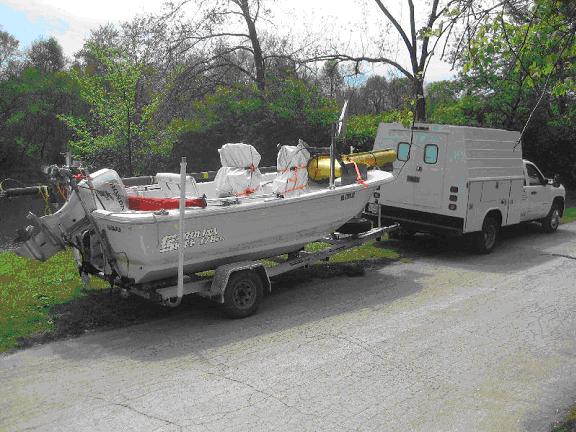
Gee, this is going to be fun.
I hung the first right turn I could and found myself in something resembling a residential neighborhood. Again, incredibly, on my left was an unbroken line of spaces along the curb. I pulled the truck and boat into them. Below is the actual location (Clifford Place).

I took a deep breath, got out of the truck, and walked around to the trailer.
Nothing was smoking.
The trailer was still attached to the truck.
The boat was still attached to the trailer.
The gear (which looks like a small submarine) was still strapped to the deck of the boat.
Whatever it was that caused the good Samaritan to honk and gesture couldn't be that bad.
I relaxed.
Then I found it. The left rear light (which, on a trailer, is a combination turn signal, brake light, and parking lamp), and with it, the licence plate, were being dragged on the ground like that guy in Game of Thrones who tried to poison Daenerus Targaryan. The aluminum right-angle bracket holding the licence plate and the light assembly to the trailer had cracked in half. Two of the wires had already ripped out from the trailer's wiring harness. The only thing holding still it there was the ground wire.
Not so bad.
I pulled the license plate off and hung it from the back of the boat. I then cajoled the light assembly into hanging onto the trailer using zip ties and Gorilla tape. I stripped fresh insulation off the wires, spliced them, and tested the light. The parking light worked but the brake and directional did not. I certainly wanted to have a working left directional, but preferred not to be troubleshooting and repairing any more than necessary on the streets of The Bronx. I thought, good enough, I'll stay in the right lane, pull off at the first available rest area, and troubleshoot more completely there.

I asked a man pushing a bottle cart how to get back to the GW bridge, "Right, right, and right," he said. I walked around the corner up to 174th street and looked to get some recon on what I was about to be driving into, but it looked ok, and even if it didn't, it's not like I had a lot of choice.
I was up and over the GW in no time. I pulled into the Vince Lombardi service area, which I've passed dozens of times in my life but never stopped at, and trouble-shot the directional. Not surprisingly, when the wires sheared, one of them touched to ground and popped a fuse. This is a modern truck with about a hundred little tiny blade fuses, but those for the trailer coupling were labeled, and they had replacements at the store in the service plaza.
The rest of the day's trip occurred without incident. I am safely ensconced in a Holiday Inn in Laurel MD. Tomorrow I simply need to skirt Washington DC before the highways and byways become more bucolic.
In conclusion, facing one's fears is overrated. Just because you're paranoid doesn't mean they're not out to get you. Just because you're worried about truck trouble in what's probably the most congested constricted choke point in the country doesn't mean it's not actually going to happen. I got out of it easy, but my love for the New York skyline notwithstanding, Route 17 and the Tappan Zee are calling my name.
Monday, April 30, 2012
The Loneliness of the Long-Distance Driver
As some of you know, in my day job (or as I sometimes say, "the portion of my life that generates income"), I'm an engineering geophysicist who develops technology to detect unexploded ordnance (dud munitions) on former military training ranges, then uses that technology to actually do what it's intended to do (that is, it's not ivory tower research that sits on a shelf). This is not the dangerous extreme occupation it sounds like. Dud ordnance are not land mines; they are not sensitively fuzed objects (and yes, in this context, fuze is spelled thusly). They do not blow up if you step on them, though disturbing them in any way is best left to explosive ordnance disposal (EOD) personnel, who are the greatest guys to drink beer with, ever.
I have a vehicular UXO detection system that is transported in a 32' trailer towed by a pickup truck. It's not a tractor-trailer, but 32' is a pretty good-sized rig to tow. The truck is a 2008 Chevy 3500 HD duallie crew cab with the Duramax turbodiesel, the Allison transmission, and a tall utility body on the back. A very nice truck that could yank a house off its foundation. You don't need a CDL (commercial driver's license) to drive it, but you need to know what you're doing. I also have an underwater UXO detection system built around a 17' Carolina Skiff, so the boat gets towed around on its trailer by the same truck. It's not as intimidating to tow as the 32' trailer, but it's still towing, which is manifestly different from zipping along in the BMW. When we deploy these systems, they need to be mobilized to job sites, so someone needs to transport them there. That someone is, usually, me.
What, Me Drive? You'd think it makes no financial sense for someone who earns an engineering salary to drive a truck. And you'd be right, and wrong. In a perfect world, a less expensive crew member would be available to hop in the truck and tow the trailer or the boat to a job site. As it happens, I'm the only crew member who is based where the equipment is. Hiring someone to drive the rig is more problematic than you'd think. Most truckers-for-hire drive their own equipment, whereas we'd need to hire someone to drive the company-owned truck (the utility body on the back of our pickup truck is stocked with necessary parts; it's not just a matter of hiring what's sometimes called a "slingshotter" to show up with his pickup to tow your trailer).
Flying another crew member in from another location to drive the rig is possible, but the way the economics work, it's often cheaper for me to drive it. Here's why. When I put together the budget for the mobilization costs for a job, if I need to fly somewhere, I budget in the travel time. If I have to fly to California, you won't be surprised that I budget in one day each way for travel. And if I have to fly somewhere close, like DC, you might be surprised that I budget in... the same amount of time, one day each way. Why? Because I can't assume I'll be doing anything else that day except for traveling for that job. Thus, there's a day each way of mob time budgeted in for me to fly to a job, whether it's nearby or across the country. So if a survey site is within a day's drive, say, 500 miles, me driving the rig is actually the cheapest option because there's essentially a free day of travel on which I would've been flying anyway. I did the calculation, and for a two-day drive, it's about a wash if I drive or if I fly in a less-expensive employee and put them up in a hotel. For three day drives and longer, it's clearly less expensive to fly someone else in. But many jobs are within 1000 miles.
I just returned from a geophysical survey of a river in Rockford IL, about 1100 miles each way, so before it all gets hazy, I thought I'd jot down these notes from the road.
The Spirit is Willing, But the Body is... Actually, Surprisingly, Almost Willing: Until about two years ago, I hadn't logged heavy road miles in many years. I have a bulged disc and sciatica. I didn't know if my body or my mind would be up to it. But with a Tempur Pedic back pillow, a well-placed dead pedal for my left foot, and a bottle of Advil just in case, my body cooperates. And my mind seems to like it. It's like the physical manifestation of repeating a mantra. I may occasionally scribble a song lyric or something on a to-do list, but you can't do heavy analytical work while driving. You need to let your mind do the road Zen thing, which is like letting the cat out. The cat wants to go out. And, since I don't mind the driving, it IS awfully convenient to load the truck, hop in it, and simply leave.
So, for jobs within a two-day drive (about 1000 miles), I'm a truck-driving man.
You Gotta Have Tunes: The first long haul I did in 2010, I took two shoeboxes full of CDs. And when I stopped the truck short because someone cut me off, both boxes slid off the passenger seat and crashed on the floor, spilling delicate discs among the detritus. I remember thinking why are you still using CDs? This is fucking stupid. It was the event that finally iPod-enabled me. It's not that I'm a Luddite (I'm an engineer, for chrissake), but I can be notoriously resistant to change if I have the perception that it's change for change's sake. The ability to carry your entire record collection (hell, it's not "your entire record collection"; it's a set of music probably a hundred times the size of what used to be "your entire record collection") on a device a third the size of a deck of cards is one of those Star Trek tricorder moments that, when the future arrives, we just yawn and don't even notice it.
Wearing The Hat: I had a professional truck driver ("JR") who used to drive for me. He moved to El Paso TX, but before he left, he took me out in the rig (which, again, is not a full-sized tractor-trailer, but a pickup truck with a utility body on the bed, towing a 32' trailer) for a lesson. JR said "when you step into the truck and sit in the seat, remember that you're working. Put your working hat on. All those things you probably do on a long drive in your own car -- fiddling with the iPod, dialing the phone, pouring yourself coffee, riffling through the food bag to find the peanuts -- don't do them. Concentrate on driving, and doing it safely." This is damned good advice. I wouldn't say I never do these when I'm driving the truck, but boy I keep them to a minimum. I set the iPod on shuffle and leave it there. I don't make calls to anyone not on speed dial. I never check e-mail or texts while driving (which isn't a sacrifice; I don't do that anyway). I rarely pour coffee as I am addicted to double-shots of espresso (more below).
The Night is Dark and Full of Terrors: Sorry, been reading too much Game of Thrones. When I was young, I used to drive anywhere, any time, any state of consciousness. I well remember Maire Anne and picking up a Drive-Away car (someone else gets their car transported across the country; you get a free car for a few days) in San Francisco in the evening, and making it into Salt Lake City around sunrise. Now, I'm good for just before dawn 'till dusk driving. I like to get rolling before dawn, 5 or 5:30am. There's something about driving in those few hours before the sun comes up that's like stealing time. From then 'till dusk, I can easily pound out 500 miles, and more. But half an hour after the sun goes down, I am done. This works well for me, and is in keeping with the DOT / logbook regulations of only driving for 11 hours in a 14 hour period. As singer/songwriter Greg Brown says, "We used to say we could drive all night. Now we don't want to."
It's Big, But Not THAT Big: A 32' trailer is not full-size (that's 53'), but it's still a pretty good-size rig to be hauling. When JR took me out for the lesson, he impressed on me the care needed for lane changes. I said "can I just put the rig in the right lane and leave it there?" He said "that's what I often do, but it doesn't keep you out of trouble, because lanes form and vanish. You can be in the right lane and all of a sudden it's exit only and you need to move over." So true. Being one step ahead of the lane dynamics as merges, exits, and tolls come and go is part of the ballet.
Mirror, Mirror (or, "I need devotion to back it up"): You don't want to be wrong about having someone in your blind spot when you change lanes while towing something. Careful adjustment of those big and little mirrors is essential, as the small ones must be aimed to eliminate the blind spots. I became comfortable at driving the rig, as long as I was going forward. However, backing up a rig using only the mirrors (the utility body on the back, and the height of the trailer itself, prevents you being able to see anything out the back window; you need to rely completely on the mirrors) is challenging. I got very good at backing it up in order to put it inside our building at work, but that's a straight shot at a ramp with a huge parking lot in front of it that gives hundreds of feet to line it up. There's a trick to backing a trailer up straight -- adjust it so there's equal amounts of the trailer in the rear view mirror. That's easy. But I still can't do the delivery truck thing where you block two lanes of traffic and back up, in one shot, to a loading dock. But I don't need to.
Why Truck Stops Suck: The first few times I drove the rig to Maryland and back, I was so concerned about being in a situation where I'd need to back up that I planned the route right down to knowing exactly where I'd buy gas each time, and verified that there was a truck stop there with a long straight shot at the pump. As it turns out, using "truck stops" is a royal pain in the butt. The diesel pumps at most truck stops, or for that matter on the truck side of many service plazas, don't accept credit cards -- instead, they take fuel account numbers. So, when you pull your little candy-ass truck up to a pump at a real truck stop, you have to get out, go inside, give them your card, go back out, fuel up, go back inside, pay and get the receipt, and come back out to find a real truck with a real driver right behind you looking like he's ready to roll right over you. For this reason, whenever possible, it's vastly preferable to stay on the car side of the car/truck divide and find the diesel pump there, if there is one, where you can just swipe a credit card and go.
It's Different for Truck Drivers: In addition to physical size (of the truck and trailer; get your mind out of the gutter), there are other potential entanglements you need to deal with when driving a truck. All those obscure signs for commercial vehicles and 5 ton GVW (Gross Vehicle Weight) apply to you. Basically, you can't drive on any road that's called a parkway. Those are for passenger vehicles only, not commercial vehicles. This is especially important in the Northeast. Roads like the Taconic Parkway in upstate New York are beautiful, but you can't include them in your route. If I'm headed south from Boston, I'd normally head over the Tappan Zee Bridge and take the Garden State Parkway, but if I'm in the truck, I can't; I either have to head way further west and cut through PA, or drive into the teeth of the beast and take the rig through NYC over the George Washington Bridge. I've now done this four times, and each time it gets easier, though the "if I get a flat here, it's going to totally suck" factor looms large. In these days where most of us program a GPS and do what it says, you need to check the route it gives you. There are GPS units specifically for truckers that in addition to keeping you off the parkways, also have bridge heights and roads with low overhanging wires programmed into them. If I do this much more, I'll probably spring for one.
And there's the log book. When I'm driving the truck for work, I'm operating a commercial vehicle, and even though I don't need a CDL, I need to fill out a logbook that shows when I'm driving versus on-duty but not driving (ie taking fuel breaks) versus off-duty, and abide by the rule of only driving for 11 hours within a 14 hour period before being off duty.
Also, when you're driving a commercial vehicle, those "when lights are flashing, all trucks take this exit for weigh station" signs apply to you. The advice is to "assume the position," meaning windows rolled down, sunglasses removed, radio off, and attitude stowed.
Service Plazas on the Turnpike: New York, New Jersey, and Ohio have wonderful service plazas on the turnpike, with drive-through diesel, food, and restrooms. Some of them even have Starbucks. But when you cross into Pennsylvania, they vanish -- you have to get off the highway for fuel and food. Drive 500 miles and you quickly appreciate the value of tax dollars at work at these plazas. I got to where I could hit the rest room, fuel up, and be rolling again in 10 minutes. In contrast, when an exit sign says "Fuel / Food," you don't know if that's 500 yards or three miles off the highway, and if you're driving a truck, you don't know whether or not there's clear access to the diesel pump. When towing, driving roads with good service plazas makes for a much less stressful trip.
And Speaking of Starbucks... I am, at this stage of my life, totally and completely coffee-addicted. It's my last monkey. (Well, that and sushi. And sex. And cars. And guitars. But that's it.) I take it very seriously. Unfortunately, coffee makes you pee. Leaving the house with a full thermos doesn't work very well for me because it just guarantees I'll need to pee 100 miles down the road. But doppios (double espressos) work great. It's like legal speed. I'll pull into a Starbucks, get two doppios (yes, that's two double espressos), drink one immediately, and set the second one aside for later. They seem to work just as well cold. The number of doppio cups that accumulated in the truck by the end of last week's 2100 mile round trip from Boston to Rockford IL was astonishing.
And Speaking of Peeing... Even though the rest stops can be whittled down to 10 or 15 minutes, when you do four of them on a long drive, you add an hour, and each time you stop, on the GPS, you see your projected arrival time tick forward, receding before you like the water in front of thirsty Tantalus. JR told me that just about every truck driver has a pee bottle in the cab. Last year I had a kidney stone removed, as as part of the post-op recovery, they gave me an actual medical pee bottle with an angled throat and a snap-tight lid. I took the bottle with me on this last road trip. I can report to you, my dutiful readers, that I can cross "pee in a bottle while driving" off my bucket list (I suppose I could've killed two birds with one stone and just peed in the bucket itself). It works, sort of, because the seating position in a truck is fairly upright. Even so, one has to pay careful attention to position, gravity, and, shall we say, the angle of the dangle. It's difficult to imagine this working in a low car like a 911. And, to get anatomical for a moment, you're sitting on your prostate, so even if you feel like you really need to pee, you can't just turn on the tap. I found it necessary to rise up off the seat to get things to, uh, flow. And this doesn't happen immediately. So you've got your pants at your knees, this strategically-positioned bottle between your legs like a feedbag on a horse, and you put on your seat belt because, well, you feel so naked not having it on (note that you are in fact partially naked), and you think if something unexpected happens RIGHT NOW and I'm in an accident, do I want the stupider thing to be that I was trying to piss into a bottle or that I didn't have my seat belt on? So you put on your seat belt which makes you feel like even more of an idiot, and with the cruise control on and your feet on the floor, you try to lift yourself up off the seat for the perhaps the two minutes it takes to unkink your internal garden hose. Then you do the deed, all the time glancing down to make sure the angle of the dangle is correct and you're actually in the bottle and it's not overflowing and you're not peeing on the seat. Then a real truck drives by, and because his cab is about two feet higher than yours, he can clearly see what you're doing, he shoots you an utterly dismissive look, and you wonder if what they say about real truck drivers is true (I mean his rig is a lot bigger). Then you see a "Rest Area 5 Miles" sign and you feel like a total fucking idiot.
Remember what I said above about wearing the truck driver hat, and things like fumbling with the iPod causing the truck to swerve? All of that is true, and more. You can see that, all in all, it's far better to time things so you hit the rest area. You need to stop for fuel anyway, and even a 10-minute leg stretch works wonders.
Plus, if you use a pee bottle, you then have a bottle full of pee in the truck. I shall say no more.
Wait In The Toll Line? Are You JOKING? If you're addicted to the EZ Pass or FastLane tag in your car and wonder why the suckers you see in line at the toll booth don't just join the 21st century and get one, imagine how much of a necessity is is when towing a rig. You really don't want to have to jostle lanes and slow down and speed up any more than necessary. Plus, it's pretty easy to scrape the trailer when you have to pull through the slowpoke lane to grab a ticket or pay the bill. When I started driving the rig two years ago, I set up a separate FastLane account from my personal one (yes, I set it up; the company couldn't figure out how to do it) with a transponder for the truck and trailer, and a second one if I'm driving the truck a la carte. At the end of a job, I log onto the FastLane web site and print out the account transactions and include them in the expense report. Last year, this worked flawlessly. On the drive out to Rockford last week, the I-Zoom tolls in Indiana and the I-Pass gates in Illinois happily accepted the FastLane pass. Some of these were Mass Pike-style 5mph drive-throughs, some had the high-speed lanes where you keep left and don't even slow down, and some were old-school wait-for-the-gate-to-lift lanes. My one complaint was that the states should standardize which lanes are electronic. In some states it's keep left, in others it's keep right, and in some the electronic lanes are in the middle. Still, a small complaint.
But at some point early into the drive home, on an old-style gated lane, the gate would not lift, and the sign flashed a red warning indicating a problem with my pass. Fortunately there's a credit card slot for such situations. When it happened a second time, I knew I couldn't use the FastLane tag and was in for a long drive home. It turns out that the credit card I'd set the account up with had expired, and once the account was $100 in arrears, it disabled the pass. Live and learn. To add insult to injury, one machine in New York state ate my credit card and would not give it back. I had to sit there, in the truck, blocking the lane, while someone came out and opened up the machine.
How You Gonna Keep 'Em Down on the Farm: We stressed-out citified Yankees forget how much of America is farmland, and it's not just Kansas and Nebraska. Driving west on I90 from Boston, through upstate NY, Pennsylvania, Ohio, Indiana, and Illinois, passing through Utica, Buffalo, Cleveland, Gary, and then Chicago, you'd expect it to be a tour of the rust belt. But it's not. It's farmland. Well, the stretch between Gary and Chicago is industrial, but even that was a pleasant surprise. I have vivid memories of driving this route in the late 70s with Maire Anne, and seeing the smog from the rubber plants in Gary from 50 miles away. It was like dusk in the middle of the day. And the smell. Some of the factories and plants are still there, and they're pumping something out the smokestacks, but it's a step change from 30 years ago. Anyone who doubts the efficacy of clean air legislation should take a time machine back to the late 70s, visit Gary, then see it now. But this stretch from Gary to Chicago is really just a brief interruption in the better part of a thousand miles of farmland.
And, Lastly, "Emergency Pull-Off" Area: Is there anyone else who finds these signs incredibly funny, or is it just my sophomoric sense of humor? I have not yet tried to use one, but I hope they at least have a picture of Jennifer Aniston somewhere. You know, as a pubic service.
I have a vehicular UXO detection system that is transported in a 32' trailer towed by a pickup truck. It's not a tractor-trailer, but 32' is a pretty good-sized rig to tow. The truck is a 2008 Chevy 3500 HD duallie crew cab with the Duramax turbodiesel, the Allison transmission, and a tall utility body on the back. A very nice truck that could yank a house off its foundation. You don't need a CDL (commercial driver's license) to drive it, but you need to know what you're doing. I also have an underwater UXO detection system built around a 17' Carolina Skiff, so the boat gets towed around on its trailer by the same truck. It's not as intimidating to tow as the 32' trailer, but it's still towing, which is manifestly different from zipping along in the BMW. When we deploy these systems, they need to be mobilized to job sites, so someone needs to transport them there. That someone is, usually, me.
What, Me Drive? You'd think it makes no financial sense for someone who earns an engineering salary to drive a truck. And you'd be right, and wrong. In a perfect world, a less expensive crew member would be available to hop in the truck and tow the trailer or the boat to a job site. As it happens, I'm the only crew member who is based where the equipment is. Hiring someone to drive the rig is more problematic than you'd think. Most truckers-for-hire drive their own equipment, whereas we'd need to hire someone to drive the company-owned truck (the utility body on the back of our pickup truck is stocked with necessary parts; it's not just a matter of hiring what's sometimes called a "slingshotter" to show up with his pickup to tow your trailer).
Flying another crew member in from another location to drive the rig is possible, but the way the economics work, it's often cheaper for me to drive it. Here's why. When I put together the budget for the mobilization costs for a job, if I need to fly somewhere, I budget in the travel time. If I have to fly to California, you won't be surprised that I budget in one day each way for travel. And if I have to fly somewhere close, like DC, you might be surprised that I budget in... the same amount of time, one day each way. Why? Because I can't assume I'll be doing anything else that day except for traveling for that job. Thus, there's a day each way of mob time budgeted in for me to fly to a job, whether it's nearby or across the country. So if a survey site is within a day's drive, say, 500 miles, me driving the rig is actually the cheapest option because there's essentially a free day of travel on which I would've been flying anyway. I did the calculation, and for a two-day drive, it's about a wash if I drive or if I fly in a less-expensive employee and put them up in a hotel. For three day drives and longer, it's clearly less expensive to fly someone else in. But many jobs are within 1000 miles.
I just returned from a geophysical survey of a river in Rockford IL, about 1100 miles each way, so before it all gets hazy, I thought I'd jot down these notes from the road.
The Spirit is Willing, But the Body is... Actually, Surprisingly, Almost Willing: Until about two years ago, I hadn't logged heavy road miles in many years. I have a bulged disc and sciatica. I didn't know if my body or my mind would be up to it. But with a Tempur Pedic back pillow, a well-placed dead pedal for my left foot, and a bottle of Advil just in case, my body cooperates. And my mind seems to like it. It's like the physical manifestation of repeating a mantra. I may occasionally scribble a song lyric or something on a to-do list, but you can't do heavy analytical work while driving. You need to let your mind do the road Zen thing, which is like letting the cat out. The cat wants to go out. And, since I don't mind the driving, it IS awfully convenient to load the truck, hop in it, and simply leave.
So, for jobs within a two-day drive (about 1000 miles), I'm a truck-driving man.
You Gotta Have Tunes: The first long haul I did in 2010, I took two shoeboxes full of CDs. And when I stopped the truck short because someone cut me off, both boxes slid off the passenger seat and crashed on the floor, spilling delicate discs among the detritus. I remember thinking why are you still using CDs? This is fucking stupid. It was the event that finally iPod-enabled me. It's not that I'm a Luddite (I'm an engineer, for chrissake), but I can be notoriously resistant to change if I have the perception that it's change for change's sake. The ability to carry your entire record collection (hell, it's not "your entire record collection"; it's a set of music probably a hundred times the size of what used to be "your entire record collection") on a device a third the size of a deck of cards is one of those Star Trek tricorder moments that, when the future arrives, we just yawn and don't even notice it.
Wearing The Hat: I had a professional truck driver ("JR") who used to drive for me. He moved to El Paso TX, but before he left, he took me out in the rig (which, again, is not a full-sized tractor-trailer, but a pickup truck with a utility body on the bed, towing a 32' trailer) for a lesson. JR said "when you step into the truck and sit in the seat, remember that you're working. Put your working hat on. All those things you probably do on a long drive in your own car -- fiddling with the iPod, dialing the phone, pouring yourself coffee, riffling through the food bag to find the peanuts -- don't do them. Concentrate on driving, and doing it safely." This is damned good advice. I wouldn't say I never do these when I'm driving the truck, but boy I keep them to a minimum. I set the iPod on shuffle and leave it there. I don't make calls to anyone not on speed dial. I never check e-mail or texts while driving (which isn't a sacrifice; I don't do that anyway). I rarely pour coffee as I am addicted to double-shots of espresso (more below).
The Night is Dark and Full of Terrors: Sorry, been reading too much Game of Thrones. When I was young, I used to drive anywhere, any time, any state of consciousness. I well remember Maire Anne and picking up a Drive-Away car (someone else gets their car transported across the country; you get a free car for a few days) in San Francisco in the evening, and making it into Salt Lake City around sunrise. Now, I'm good for just before dawn 'till dusk driving. I like to get rolling before dawn, 5 or 5:30am. There's something about driving in those few hours before the sun comes up that's like stealing time. From then 'till dusk, I can easily pound out 500 miles, and more. But half an hour after the sun goes down, I am done. This works well for me, and is in keeping with the DOT / logbook regulations of only driving for 11 hours in a 14 hour period. As singer/songwriter Greg Brown says, "We used to say we could drive all night. Now we don't want to."
It's Big, But Not THAT Big: A 32' trailer is not full-size (that's 53'), but it's still a pretty good-size rig to be hauling. When JR took me out for the lesson, he impressed on me the care needed for lane changes. I said "can I just put the rig in the right lane and leave it there?" He said "that's what I often do, but it doesn't keep you out of trouble, because lanes form and vanish. You can be in the right lane and all of a sudden it's exit only and you need to move over." So true. Being one step ahead of the lane dynamics as merges, exits, and tolls come and go is part of the ballet.
Mirror, Mirror (or, "I need devotion to back it up"): You don't want to be wrong about having someone in your blind spot when you change lanes while towing something. Careful adjustment of those big and little mirrors is essential, as the small ones must be aimed to eliminate the blind spots. I became comfortable at driving the rig, as long as I was going forward. However, backing up a rig using only the mirrors (the utility body on the back, and the height of the trailer itself, prevents you being able to see anything out the back window; you need to rely completely on the mirrors) is challenging. I got very good at backing it up in order to put it inside our building at work, but that's a straight shot at a ramp with a huge parking lot in front of it that gives hundreds of feet to line it up. There's a trick to backing a trailer up straight -- adjust it so there's equal amounts of the trailer in the rear view mirror. That's easy. But I still can't do the delivery truck thing where you block two lanes of traffic and back up, in one shot, to a loading dock. But I don't need to.
Why Truck Stops Suck: The first few times I drove the rig to Maryland and back, I was so concerned about being in a situation where I'd need to back up that I planned the route right down to knowing exactly where I'd buy gas each time, and verified that there was a truck stop there with a long straight shot at the pump. As it turns out, using "truck stops" is a royal pain in the butt. The diesel pumps at most truck stops, or for that matter on the truck side of many service plazas, don't accept credit cards -- instead, they take fuel account numbers. So, when you pull your little candy-ass truck up to a pump at a real truck stop, you have to get out, go inside, give them your card, go back out, fuel up, go back inside, pay and get the receipt, and come back out to find a real truck with a real driver right behind you looking like he's ready to roll right over you. For this reason, whenever possible, it's vastly preferable to stay on the car side of the car/truck divide and find the diesel pump there, if there is one, where you can just swipe a credit card and go.
It's Different for Truck Drivers: In addition to physical size (of the truck and trailer; get your mind out of the gutter), there are other potential entanglements you need to deal with when driving a truck. All those obscure signs for commercial vehicles and 5 ton GVW (Gross Vehicle Weight) apply to you. Basically, you can't drive on any road that's called a parkway. Those are for passenger vehicles only, not commercial vehicles. This is especially important in the Northeast. Roads like the Taconic Parkway in upstate New York are beautiful, but you can't include them in your route. If I'm headed south from Boston, I'd normally head over the Tappan Zee Bridge and take the Garden State Parkway, but if I'm in the truck, I can't; I either have to head way further west and cut through PA, or drive into the teeth of the beast and take the rig through NYC over the George Washington Bridge. I've now done this four times, and each time it gets easier, though the "if I get a flat here, it's going to totally suck" factor looms large. In these days where most of us program a GPS and do what it says, you need to check the route it gives you. There are GPS units specifically for truckers that in addition to keeping you off the parkways, also have bridge heights and roads with low overhanging wires programmed into them. If I do this much more, I'll probably spring for one.
And there's the log book. When I'm driving the truck for work, I'm operating a commercial vehicle, and even though I don't need a CDL, I need to fill out a logbook that shows when I'm driving versus on-duty but not driving (ie taking fuel breaks) versus off-duty, and abide by the rule of only driving for 11 hours within a 14 hour period before being off duty.
Also, when you're driving a commercial vehicle, those "when lights are flashing, all trucks take this exit for weigh station" signs apply to you. The advice is to "assume the position," meaning windows rolled down, sunglasses removed, radio off, and attitude stowed.
Service Plazas on the Turnpike: New York, New Jersey, and Ohio have wonderful service plazas on the turnpike, with drive-through diesel, food, and restrooms. Some of them even have Starbucks. But when you cross into Pennsylvania, they vanish -- you have to get off the highway for fuel and food. Drive 500 miles and you quickly appreciate the value of tax dollars at work at these plazas. I got to where I could hit the rest room, fuel up, and be rolling again in 10 minutes. In contrast, when an exit sign says "Fuel / Food," you don't know if that's 500 yards or three miles off the highway, and if you're driving a truck, you don't know whether or not there's clear access to the diesel pump. When towing, driving roads with good service plazas makes for a much less stressful trip.
And Speaking of Starbucks... I am, at this stage of my life, totally and completely coffee-addicted. It's my last monkey. (Well, that and sushi. And sex. And cars. And guitars. But that's it.) I take it very seriously. Unfortunately, coffee makes you pee. Leaving the house with a full thermos doesn't work very well for me because it just guarantees I'll need to pee 100 miles down the road. But doppios (double espressos) work great. It's like legal speed. I'll pull into a Starbucks, get two doppios (yes, that's two double espressos), drink one immediately, and set the second one aside for later. They seem to work just as well cold. The number of doppio cups that accumulated in the truck by the end of last week's 2100 mile round trip from Boston to Rockford IL was astonishing.
And Speaking of Peeing... Even though the rest stops can be whittled down to 10 or 15 minutes, when you do four of them on a long drive, you add an hour, and each time you stop, on the GPS, you see your projected arrival time tick forward, receding before you like the water in front of thirsty Tantalus. JR told me that just about every truck driver has a pee bottle in the cab. Last year I had a kidney stone removed, as as part of the post-op recovery, they gave me an actual medical pee bottle with an angled throat and a snap-tight lid. I took the bottle with me on this last road trip. I can report to you, my dutiful readers, that I can cross "pee in a bottle while driving" off my bucket list (I suppose I could've killed two birds with one stone and just peed in the bucket itself). It works, sort of, because the seating position in a truck is fairly upright. Even so, one has to pay careful attention to position, gravity, and, shall we say, the angle of the dangle. It's difficult to imagine this working in a low car like a 911. And, to get anatomical for a moment, you're sitting on your prostate, so even if you feel like you really need to pee, you can't just turn on the tap. I found it necessary to rise up off the seat to get things to, uh, flow. And this doesn't happen immediately. So you've got your pants at your knees, this strategically-positioned bottle between your legs like a feedbag on a horse, and you put on your seat belt because, well, you feel so naked not having it on (note that you are in fact partially naked), and you think if something unexpected happens RIGHT NOW and I'm in an accident, do I want the stupider thing to be that I was trying to piss into a bottle or that I didn't have my seat belt on? So you put on your seat belt which makes you feel like even more of an idiot, and with the cruise control on and your feet on the floor, you try to lift yourself up off the seat for the perhaps the two minutes it takes to unkink your internal garden hose. Then you do the deed, all the time glancing down to make sure the angle of the dangle is correct and you're actually in the bottle and it's not overflowing and you're not peeing on the seat. Then a real truck drives by, and because his cab is about two feet higher than yours, he can clearly see what you're doing, he shoots you an utterly dismissive look, and you wonder if what they say about real truck drivers is true (I mean his rig is a lot bigger). Then you see a "Rest Area 5 Miles" sign and you feel like a total fucking idiot.
Remember what I said above about wearing the truck driver hat, and things like fumbling with the iPod causing the truck to swerve? All of that is true, and more. You can see that, all in all, it's far better to time things so you hit the rest area. You need to stop for fuel anyway, and even a 10-minute leg stretch works wonders.
Plus, if you use a pee bottle, you then have a bottle full of pee in the truck. I shall say no more.
Wait In The Toll Line? Are You JOKING? If you're addicted to the EZ Pass or FastLane tag in your car and wonder why the suckers you see in line at the toll booth don't just join the 21st century and get one, imagine how much of a necessity is is when towing a rig. You really don't want to have to jostle lanes and slow down and speed up any more than necessary. Plus, it's pretty easy to scrape the trailer when you have to pull through the slowpoke lane to grab a ticket or pay the bill. When I started driving the rig two years ago, I set up a separate FastLane account from my personal one (yes, I set it up; the company couldn't figure out how to do it) with a transponder for the truck and trailer, and a second one if I'm driving the truck a la carte. At the end of a job, I log onto the FastLane web site and print out the account transactions and include them in the expense report. Last year, this worked flawlessly. On the drive out to Rockford last week, the I-Zoom tolls in Indiana and the I-Pass gates in Illinois happily accepted the FastLane pass. Some of these were Mass Pike-style 5mph drive-throughs, some had the high-speed lanes where you keep left and don't even slow down, and some were old-school wait-for-the-gate-to-lift lanes. My one complaint was that the states should standardize which lanes are electronic. In some states it's keep left, in others it's keep right, and in some the electronic lanes are in the middle. Still, a small complaint.
But at some point early into the drive home, on an old-style gated lane, the gate would not lift, and the sign flashed a red warning indicating a problem with my pass. Fortunately there's a credit card slot for such situations. When it happened a second time, I knew I couldn't use the FastLane tag and was in for a long drive home. It turns out that the credit card I'd set the account up with had expired, and once the account was $100 in arrears, it disabled the pass. Live and learn. To add insult to injury, one machine in New York state ate my credit card and would not give it back. I had to sit there, in the truck, blocking the lane, while someone came out and opened up the machine.
How You Gonna Keep 'Em Down on the Farm: We stressed-out citified Yankees forget how much of America is farmland, and it's not just Kansas and Nebraska. Driving west on I90 from Boston, through upstate NY, Pennsylvania, Ohio, Indiana, and Illinois, passing through Utica, Buffalo, Cleveland, Gary, and then Chicago, you'd expect it to be a tour of the rust belt. But it's not. It's farmland. Well, the stretch between Gary and Chicago is industrial, but even that was a pleasant surprise. I have vivid memories of driving this route in the late 70s with Maire Anne, and seeing the smog from the rubber plants in Gary from 50 miles away. It was like dusk in the middle of the day. And the smell. Some of the factories and plants are still there, and they're pumping something out the smokestacks, but it's a step change from 30 years ago. Anyone who doubts the efficacy of clean air legislation should take a time machine back to the late 70s, visit Gary, then see it now. But this stretch from Gary to Chicago is really just a brief interruption in the better part of a thousand miles of farmland.
And, Lastly, "Emergency Pull-Off" Area: Is there anyone else who finds these signs incredibly funny, or is it just my sophomoric sense of humor? I have not yet tried to use one, but I hope they at least have a picture of Jennifer Aniston somewhere. You know, as a pubic service.
Friday, March 30, 2012
Making the Un-Adjustable Adjustable
Last summer, after Ethan cracked up the MPV, we got him a 2004 Ford Focus (and I assure you, the transition from “totaled the family minivan” to “here’s another car” happened with the same sense of grace and calm as childbirth). The purchase of the Focus ZX3 (two-door hatchback) was a crime of opportunity: I was doing a lot of traveling; I didn’t want him using my BMW wagon; we were looking for a small, easy-on-gas 5-speed; Japanese cars were too pricey; this one needed odds and ends but cost just $2500, had 100k, and the air conditioning worked.
Roundel readers may recall that I, and then Ethan, spent a few years driving a 3-cylinder 5-speed Geo Metro. The Metro was incredible on gas – if you drove it at 55mph on the highway, it did get 53mpg – but it was not a solution that was supportable in the long term. It was more of a parlor trick. Yes the car got amazing mileage, but that was traded off in was most consumers would run from. It was a tin can, uncomfortable to ride in. It had worse acceleration than a '75 Ford Pinto. And the metal was so thin that components on the undercarriage rusted like a throwback to the 70s.
Fast-forward to the Focus. In some ways, I kind of like it. The suspension has all the subtlety of a pogo stick, but the engine has a surprising amount of zip and the shifter is very precise and tight. I haven't measured the mileage at 55mph the way I did with the Metro, but it seems easy on gas.
Ethan left abruptly in January to rejoin Americorps, and I re-inherited the Focus. My youngest son Aaron has his learner’s permit, so better that he burn out the clutch on the Focus while he's learning than Maire Anne’s 2008 Honda Fit my 2001 BMW 325XiT, or, heaven forbid, any of the “fun cars.” So I started driving the Focus to see what damage Ethan had done to it and what needed to be done to ready it for Aaron’s driving lessons.
As I drove it, I was immediately greeted by a cacophony of bangs and buzzes. Man, I thought, this thing makes my 2002 seem quiet. The noises were coming from both front and rear. I addressed the rear first. Turns out the latch for the rear hatch was banging and raising quite a racket. Fortunately, like every car on the planet, the latch for the rear hatch was adjustable, and with a few turns of the wrench, I lowered the latch on its adjustment screws so the hatch snugged down.
Next, the noise in the front. I remembered that, when we bought the car, the hood looked slightly mis-aligned. And in addition to the gap between the hood and the fenders, the hood had a fair amount of play, allowing it to bounce up and down and bang against the latch.
So I did what any DIY mechanic would do. I looked for the hood latch adjustment. I found the two 10mm bolts holding the latch in place, loosened them (itself not an easy task since access to the bolts is impeded by a plastic assembly the latch sits in), and tried the slide the latch downward to adjust it.
It wouldn't move.
It wouldn't move.
It’s not adjustable.
Oh, right, the LATCH isn't adjustable, but he “striker” part of the hood latch – the rod in the bracket that’s bolted to the underside of the hood – must be.
Wrong again.
Not only isn’t adjustable, it’s tack-weleded in place. You can’t even remove it without busting the weld.
Wha-WHAT? How could the hood latching system not be adjustable? What am I missing?
I read on some Focus-related web sites that, yes, incredibly, the latch is not adjustable. The recommendation was that, if it has play, it's probably bad and you have to replace it. I found a new one on Rockauto for $23. Sure, I thought, I'll throw twenty three bucks at a rattling banging hood and see if it solves the problem.
When the new latch arrived, I tried removing the old one, and was stunned to find you can’t remove it without either pulling the radiator and condenser or destroying a piece of the nose of the car (again, confirmed on Focus message boards).
So, despite my feeling that the Focus was a cut above the Metro, clearly it was designed with the same use-it-and-throw-it away mentality.
So, despite my feeling that the Focus was a cut above the Metro, clearly it was designed with the same use-it-and-throw-it away mentality.
Then, I found one post that mentioned “notching” the cage in which the latch is held so the latch could come out.
Right up my alley.
I used a Dremmel tool to cut a thin notch in the plastic, allowing the old latch to be pulled out and the new one installed. Initially I cut a thin notch that let me pull the latch out by passing only the metal backing plate that runs wide of the latch body through the notch, but then I wound up expanding the notch to create some room for the 10mm ratchet wrench to turn, making it so it would rotate more like 1/8 of a turn at a time, instead of 1/16.

When I got the old latch out, I could see that the latch DID have elongated holes that one would've thought could be used to lower the latch, allowing a tighter hood closing. But when I put the new latch in, just like the old one, it wouldn't slide down on the elongated holes; it seemed set in one position. And the new latch didn't pull the hood any tighter than the old one. So much for the "throw $23 at it" solution.
It made no sense that the latch had elongated holes for adjustment but wouldn't move. Clearly something was preventing it from sliding up and down.
Then I saw that the front of the latch had two plastic nibs on it that were meant to sit in grooves in the plastic nose piece in the car. You can see the nibs in the pic below, and one of the triangular notches where the right nib is supposed to sit in the above picture.

I took a wood chisel and sheared off the two plastic nibs. Now, finally, the latch was free to slide down on those oval adjustment holes.
Then I saw that the front of the latch had two plastic nibs on it that were meant to sit in grooves in the plastic nose piece in the car. You can see the nibs in the pic below, and one of the triangular notches where the right nib is supposed to sit in the above picture.

I took a wood chisel and sheared off the two plastic nibs. Now, finally, the latch was free to slide down on those oval adjustment holes.

It turns out the car had been tapped, very lightly, on the front bumper, and that had caused the latched to be pushed slightly upward. I get that there are design choices to be made in setting the price point of a car, but why anyone would design something this way, where the latch itself is supposed to be adjustable but the mechanical structure holding it in place prevents it from being so, seems incredibly short-sighted.
It still may be a disposable car, but at least it's quiet.
It still may be a disposable car, but at least it's quiet.
Sunday, March 18, 2012
Wrench For Hire (sort of)
With my reduction in hours at work, I’ve taken the first tentative steps in the direction of repairing cars for other people. This is huge for me, as there are four chapters in my upcoming book, each titled “Why I Don’t Work On Other People’s Cars” (parts I through IV), each of which details the slow-motion train wreck of doing a favor for someone and having something go wrong, and each ending with the self-admonition “I am never going to do this again, ever.”
But I thought I’d dip a toe in the water of hired wrench, carefully choosing the pond to be that of enthusiast cars and their owners. I sent an e-mail to the Nor’East 02ers Group essentially saying “I’m not really a doctor, I just play one on TV, but if you want your appendix removed cheaply, I might be your guy.” I quickly received several responses. The first customer was Charlie, a lovely, easy-going, laid-back gentleman with a pretty Chamonix (white) ’73 2002. In addition to wanting the fluids changed and the valves adjusted, he wanted to learn how to fix the car himself. So this was not to be a drop-it-off-and-fix-it arrangement; he wanted to, essentially, contract me to be the Hack Mechanic I so often pretend to be and hang out with me in my garage and absorb the Hack Mechanic Way. The idea that this might be of value to someone never even crossed my mind.
At the first repair session, we drained the transmission and differential fluids and filled them with Redline, then moved onto the brakes. We were flushing the brake fluid, starting with the wheel furthest from the master cylinder (right rear), when I immediately found that no fluid was coming out of the wheel cylinder, indicating the rubber brake line had swollen itself shut.
This is the classic “rhythm of repair” issue I write about in my upcoming book. You have a car up on jack stands and are in the middle of some repair or procedure when you find the problem is more extensive than you thought, and the mission creeps, and you need additional parts. You, however, are not a BMW dealer; you don’t have a warehouse full of parts behind the repair facility. Neither are you an independent repair shop with contracts with a network of local suppliers who will drop parts by your place of business. You might try to locate said part, but if it’s 4pm on a Saturday, the odds are very much against you. Fortunately, with Charlie’s swollen brake lines, the car had not been immobilized; I could simply put the wheel back on, take the car down off the lift, say “buy new brake lines and call me when you have them,” and send Charlie on his way.
The next repair session, Charlie came with the brake lines and a new set of rear Bilsteins. We installed them both without incident. Maybe, I thought, this working on other people’s cars will be okay. Maybe the curse is gone.
In our third repair session, Charlie came with new Bilstein front struts. Installation of these requires removing the caliper, unbolting the strut from the ball joint at the bottom, detaching the strut bearing at the top from the fender, laying the entire assembly on the floor, compressing the spring, and removing the bearing – all in order to replace the strut cartridge. Typically the most challenging part of this in BMW 2002 is reaching and loosening the one of the three ball joint bolts whose access is occluded by the lower control arm. The trick is to jack up the strut (that’s right – put a jack under the ball joint, on a car that’s already up on jack stands) to change the angle of the lower control arm so it’s not blocking the troublesome bolt. Even doing this, you can only access the bolt with a box-end wrench, not a ratchet wrench and certainly not an air impact wrench, and in a 39 year-old car, it often doesn’t relinquish its tightly-held position easily. Fortunately on Charlie’s car these bolts came right out.
I thought we were home-free.
Foolish me.
We pulled out the first strut assembly, put it on the floor of the garage, compressed the spring with a set of old-fashioned claw compressors, zipped off the big bearing nut at the top with my impact wrench, pulled off the bearing and the spring, and then proceeded to try and take off the big collar nut holding in the strut cartridge. Because the strut tube is several inches in diameter, and because a traditional hex nut would be too big to allow the dust bellows to slide over the tube, these collar nuts are not normal hex nuts – that is, you can’t simply take a big wrench to them. The original nuts are round with two holes in them, intended to receive a large BMW special tool with two pins in it. Very few backyard mechanics own this tool (I don’t), but that’s okay because typically you can simply take a pair of large slip-joint pliers (the BFPs, as I affectionately refer to them) and crank the nut off.
We tried that. Nothing.
Ok, then, the next level of attack is to put a dull chisel into one of the pin holes and smack it repeatedly with a sledgehammer.
Nope.
Ultimately, getting off stuck nuts is about torque and grip. You can increase torque by increasing the lever arm. If the torque exceeds the grip, the nut comes off, but at some point the grip of the nut may exceed the torque you’re trying to apply, and something gives, and that something is not the something you want. Slip-joint pliers on a round collar nut do not have the grip of a hex wrench on a hex nut, so at first the thing that gave was the ability to hold the nut. I put my hands all the way on the end of the BFPs and squeezed as hard as I could. The next thing that gave was Charile’s ability to hold the assembly still on the garage floor. I found a long piece of angle iron and bolted it to the bracket on the strut housing that is there to hold the brake lines. Charlie stood on both the housing and the angle iron while I grunted and bore down hard on the pliers. The whole assembly started to turn, but not because the nut was loosening; it was moving because we were bending the bracket for the brake line.
We stopped and assessed. We were in real danger of not being able to get the collar nut off, but we had not destroyed anything, at least not yet. Charlie remembered that a Nor’East 02ers member had advertised a pair of cleaned, powder-coated strut housings for a hundred bucks. In addition, I was fairly certain I had an old set under the front porch of my mother’s house. So, if worst came to worst, we had an out that was timely and of acceptable cost.
With that in mind, I figured we had nothing to lose. The only function of the bracket on the strut housing was to hold the brake lines. It was not a structural piece. It could be bent, then straightened, without any loss of functionality of compromising of safety. So I hauled out the only card I had left to play.
The torch.
An oxy-acetylene torch, with its foot-long flame, is a scary-looking thing that can easily melt nearby wiring, but there’s no safer way to use it than with the assembly to which you want to apply it lying prostrate on the garage floor. I heated the collar nut, then tried the BFPs. Nope.
I did it a second time until the nut began to smoke. Still no action.
I sighed, then with that “well, nothing left to lose might as well go for broke” attitude that virtually guarantees either success or abject miserable failure, put so much heat on the collar nut that not only smoke but flame and particulate matter poured forth from what I assumed at the time (verified upon later postmortem) was the rubber seal at the top of the old strut cartridge melting. One last time, with Charlie standing on the angle iron and the strut and me doing my Hack Mechanic pumping iron bit, I squeezed, bore down, and the wrench rotated.
The collar nut came off.
As is often the case with a bilateral repair, we did the same thing on the other side, only instead of screwing around with other methods, we went straight for the bolt-it-to-the-angle-iron-and-heat-it-until-it-smokes technique. Whereas the first one took two hours I think we had the second one apart inside of 20 minutes.
Having dodged the bullet on the collar nuts, the only remaining hiccup was the spring perch rubber. On one of the struts, the rubber spacer that sits between the spring perch and the spring had partially dissolved. Bavarian Auto Sport in Portsmouth NH is open ‘till 4pm on Saturdays, but I called them and they did not have this part in stock. Charlie got on the phone and called a few Nor’East 02ers, and, miraculously, an acquaintance of his named William appeared to have a pair. Charlie e-mailed him a pic on his iPhone so William could verify he had the correct part.
Further, William was looking for an excuse to go for a ride and offered to drive the parts down to my house so we could complete the repair by the end of the day. If there’s anything that exemplifies the wonderful sense of connection that people have via a shared interest, this is it.
About an hour later, a big BMW touring bike with two big hard saddle bags on the back rode into my driveway, and William, outfitted in full BMW-logo’d riding gear, stepped off. He opened one of the containers and pulled out a cardboard box full of parts, from which he produced the rubber spacers. I looked at them and realized that, unfortunately, they were not for the front spring perches but for the rear. Charlie would’ve had to have taken a photograph from the side in order for William to have been able to tell the difference. But this in no way detracted from our sense of gratitude, or the pleasure of the quick half hour that elapsed swapping a few 2002-related war stories.
Charlie has since located the spacers at Pelican and is having them Fedexed to his house for Tuesday delivery. His pretty Chaminox 2002 is currently sojourning in my garage. It looks very much at home, sitting up on the lift. Too bad I have to give it back.
Maybe this working on other people's cars thing isn't so bad after all...
Maybe this working on other people's cars thing isn't so bad after all...

Saturday, January 28, 2012
I Was Phished (and I don't mean seduced by Trey Anastasio)
We've all gotten the e-mails for Viagra and penis enlargers, and from the poor deposed Nigerian royalty asking us to cash his bank check in exchange for which he will give us a percentage (ok maybe only I get the ones for Viagra and penis enlargers). Only a rube who fell off the turnip truck would respond to these.
But I, who consider myself a very Internet-savvy guy, got phished this morning.
Here's how it works. You get a perfectly legitimate-looking e-mail from a web site with whom you have an existing account, like eBay, Amazon, Yahoo, your bank, etc. It catches your attention with some alarming statement such as a missed payment or compromised account security, and has a link for you to click to log in and fix it. So you do. It presents a page that looks for all the world like the site you're accustomed to. You log in with your name and password like you always do. And then you see something that isn't right, and you realize you've just given away your password.
In my case, it was eBay. A few days ago I sold five dead notebook computers. All the buyers paid me. I boxed the computers up and shipped them off. But this morning, I got an e-mail on my Yahoo account that was a message forwarded from eBay from the buyer of one of the computers. It said, essentially, "I paid for this several days ago I've gotten no shipping information from you what gives?" It looked for all the world like every other message e-mail I've ever gotten from eBay as the result of an auction, with the familiar logos, fonts, and color schemes. It even showed a picture of the computer being auctioned.
So I clicked the "respond" button in the e-mail, which took me to eBay like it always does. I logged in with my eBay ID and password, and then saw a screen asking me to confirm my identity by entering in the credit card number used to support this eBay account.
That's not right.
Suddenly the red light went on.
Phished! Shit! Piss!! FUCK!!!
I IMMEDIATELY went to eBay (the REAL eBay), logged in, changed my password, and logged back out. I logged back in with the changed password, checked my messages within eBay, and of course there was no such message.
I then went back to the fake e-mail and used my mouse to hover over the "respond" button. Doing this lets you see the URL address that the link will take you too. Needless to say, it showed an address that was NOT eBay.
I've previously warned Maire Anne and the kids about phishing, and shown them this trick of using the mouse to hover over a link, but this one caught me. The safe thing to do is NEVER click on these links within an e-mail, and instead ALWAYS go directly to the web site (eBay, PayPal, Amazon, whoever) and check your account status.
So now, with my guard back up, I'll try and relax. Maybe listen to "Sample in a Jar."
But I, who consider myself a very Internet-savvy guy, got phished this morning.
Here's how it works. You get a perfectly legitimate-looking e-mail from a web site with whom you have an existing account, like eBay, Amazon, Yahoo, your bank, etc. It catches your attention with some alarming statement such as a missed payment or compromised account security, and has a link for you to click to log in and fix it. So you do. It presents a page that looks for all the world like the site you're accustomed to. You log in with your name and password like you always do. And then you see something that isn't right, and you realize you've just given away your password.
In my case, it was eBay. A few days ago I sold five dead notebook computers. All the buyers paid me. I boxed the computers up and shipped them off. But this morning, I got an e-mail on my Yahoo account that was a message forwarded from eBay from the buyer of one of the computers. It said, essentially, "I paid for this several days ago I've gotten no shipping information from you what gives?" It looked for all the world like every other message e-mail I've ever gotten from eBay as the result of an auction, with the familiar logos, fonts, and color schemes. It even showed a picture of the computer being auctioned.
So I clicked the "respond" button in the e-mail, which took me to eBay like it always does. I logged in with my eBay ID and password, and then saw a screen asking me to confirm my identity by entering in the credit card number used to support this eBay account.
That's not right.
Suddenly the red light went on.
Phished! Shit! Piss!! FUCK!!!
I IMMEDIATELY went to eBay (the REAL eBay), logged in, changed my password, and logged back out. I logged back in with the changed password, checked my messages within eBay, and of course there was no such message.
I then went back to the fake e-mail and used my mouse to hover over the "respond" button. Doing this lets you see the URL address that the link will take you too. Needless to say, it showed an address that was NOT eBay.
I've previously warned Maire Anne and the kids about phishing, and shown them this trick of using the mouse to hover over a link, but this one caught me. The safe thing to do is NEVER click on these links within an e-mail, and instead ALWAYS go directly to the web site (eBay, PayPal, Amazon, whoever) and check your account status.
So now, with my guard back up, I'll try and relax. Maybe listen to "Sample in a Jar."
Subscribe to:
Posts (Atom)