Wednesday, July 8, 2015

A Funny Thing Happened on the Way to the Vintage -- Part III

When we ended last week, Brian Ach’s recalcitrant stumbling stuttering ’73 2002tii that betrayed him and his wife Michelle in northern Virginia on the way to The Vintage had been towed to my house in Massachusetts. I’d offered to fix it. For free. So I could rewrite the ending to the story where I’d failed to fix it on the road. My plan was to throw equal parts logic, ego, and components stolen off my own tii at it until it or I cried uncle.
It seemed like a good idea at the time.
Now, there’s an expression in troubleshooting: Plan the work, work the plan. For a tough problem, take your emotions out of it. Don’t follow pet theories. Don’t take shortcuts. Sure, prioritize things that are more likely, and leave the ugliest least likely most expensive possibilities for last, but develop a systematic approach and execute it. If the approach is sound, you’re highly likely to solve the problem, sometimes in spite of yourself. So my plan for to finding and fixing the problem in Brian’s car was this:
·        Do a compression test to rule out anything mechanical and catastrophic.
·        Adjust the valves while the engine is cold… because adjusting valves makes me feel connected with a car.
·        Check that the TDC mark on the front of the crankshaft agrees with the one on the flywheel. (Paul Wegweiser’s crankshaft pulley was once installed backward, and the two marks were off from one another.)
·        Check that, at TDC, the camshaft mark lines up with the mark in the head.
·        Recheck the mark on the pulley of the Kugelfischer pump to verify it also lines up correctly.
·        Recheck the dynamic ignition timing and the basic advance functionality of the distributor
·        Verify that the voltage at both the battery and the coil is about 14 volts with the engine running and doesn’t vary much with engine RPM.
·        Drive my tii and verify that it runs correctly.
·        Drive Brian’s tii and verify that the problem still exists.
·        Swap the entire ignition system from my tii – dizzy, Pertronix, cap, rotor, coil, resistor, plugs, plug wires, everything.
·        If the problem goes away, begin swapping ignition parts back until the problem reappears to determine which component is bad.
·        If, instead, the problem persists, start to do something similar with the fuel system. Don’t swap everything right off the bat because pulling two Kugelfischer injection pumps and eight injectors and swapping them is a bit of a pain. Plus, the injection pumps are extremely reliable; when you hear hoof beats, think horses, not zebras and all that.
·        Start with the fuel pump – logical, since Brian’s had low fuel pressure (24 psi where it should have 29). Check fuel volume as well.
·        If necessary, use my portable exhaust gas analyzer to see what the thing is doing (rich or lean) when it’s running terribly.
·        If necessary, use an IR thermometer to help locate a weak performing cylinder.
·        If that doesn’t work, look at the gas, draining the tank and trying clean branded gas if necessary.
·        If that doesn’t work, systematically go through the entire fuel system.
·        If that doesn’t work, read up on how to cover up insurance fraud.
I was a man with a plan.
But if you asked me what I thought… There’s that old saying “your fuel problems are in your ignition.” Always suspect the ignition first. Plus, Brian’s fuel system was known good.
With that sly opening, let me offer a meditation on the concept of known good. Because if you don’t understand this, you can’t truly appreciate how weird the events that unfolded were.
About two years ago, during a general sort-out of my own tii, I was having terrible problems. I’d just had the distributor rebuilt by a highly reputable shop, and installed it and a new Bosch Red coil, the correct matching Bosch Red ballast resistor, new plugs and plug wires, and new points and condenser, the latter two procured from a BMW dealer in BMW logo’d boxes with BMW part numbers. But the car ran horribly. With all those new ignition parts, it clearly seemed to be a fuel problem. I posted my trials and tribs. My friend Lindsey Brown, a pro, texted me. “Can I come over and play?” he asked. He showed up with a distributor that looked, shall we say, experienced. “This,” he proclaimed, “is known good. I pulled it out of my own running 2002 this morning. Let’s put it into your car.”
“How can you say,” I retorted,” that that’s known good? MY distributor is known good. It was just professionally rebuilt. The points and condenser are brand spanking new. It’s certainly more known good than yours. It can’t be the problem.”
“Are you or are you not having a problem you can’t figure out?”
“Well… yes.”
“Then humor me,” he said. “Let’s put in my distributor and see what happens.”
My response was, essentially, “grumble… bitch… gripe… I’ll show you known good.
We removed my essentially new dizzy and replaced it with Lindsey’s beat-up-looking one. I started my car. The problem was gone. I picked my jaw up off the floor.
“Now,” said the professional, “let’s transfer one component at a time from your distributor onto this one until we find out what is actually causing the problem.
It turned out that the culprit was the brand new condenser that I’d purchased from a dealer in a BMW logo’d box. It lasted about five miles before it died.
It was in this experience that I learned what was probably the most important diagnostic lesson in my Hack Mechanic life: There is no known good. There is only diagnosis.
Let that one seep into your bones for a few weeks until it’s part of your DNA. I’ve experienced this same thing in my engineering career, but it usually takes a slightly different form: Whenever you say “it can’t be X,” you’re admitting you have a blind spot surrounding X. Remove it. Because it may well be X and you need to be able to see or at least consider that.
Next, you must permit me a Star Trek moment. In the “Wink of an Eye” episode, Kirk and another crewman are kidnapped and taken into an accelerated timeframe. They move so quickly that they can’t be seen by the non-accelerated crew, only perceived as a faint buzzing. Kirk tries to communicate with the crew by recording a message and leaving it in what can only be described as the Enterprise’s 8 Track tape deck. Spock finds it and listens to it, but the tape contains only buzzing. At some later point, after the crew finds structures built around the Enterprise’s engines with no visible evidence of people, only buzzing, the light bulb goes on for Mr. Spock. He hears the buzzing again, and he says to McCoy “I know what it is.” He’s figured the acceleration thing out. He retrieves the tape, slows it down, and can now hear the captain’s message.
The point in all that geekiness is that, most of the time, we don’t get to say I know what it is, which appears to be the Vulcan equivalent of eureka. It’s really rather rare, at least for me, to look at and think about a car problem and engage it so rationally that it leads me inexorably to a path where I do one test, go “a-HA!” know that I’ve found the answer, and pat myself on the back for my diagnostic skills. Most of the time, you just need to pound it out. And, by the time you do, you’re often robbed of that “eureka” moment because you’ve spent a boatload of time and money, you’re tired, and instead of eureka, your reaction is often “THAT was it? You have got to be shitting me.”
I began to execute the plan. I did the timing and voltage checks. It made no difference. I then drove my tii and verified that it ran fine. In one of those big circle of life things, my distributor that had been thought good but actually bad was now the one that was known good, or as close as you can get. I put the two cars nose-to-nose in the garage like a rotated scene out of Frankenstein. I pulled the ignition out of Brian’s car and put it in a box. I then yanked the entire ignition – everything – out of my tii and installed it into Brian’s. As I was doing so, I had the thought “you know, this is really too big of a chunk to do at once. Plugs and plug wires, coil and resistor… probably not necessary. You’re going to have to swap them back when you start this puppy up, drive it, and the problem is gone. You probably should’ve swapped only the dizzy and its components.”
But, hey, plan the work, work the plan, right? Everything was swapped, I started Brian’s tii up, pulled it out of the garage, drove it around the block, and…
No difference.
Well, then. Wasn’t that cagey of me to misdirect you by floating three times how much I regretted not having had a distributor with me when I looked at the car in the parking lot? In truth I had regretted it, right up until this moment when I realized it would’ve made no difference.
I came inside and told all this to Maire Anne. She’d heard me explaining “the plan.”
“So,” she said, “that means it can’t be an ignition problem, right?”
I was careful.
“No,” I said, “it means I don’t see how it could be an ignition problem.” Remember—try not to have blind spots.
The path was clear. If it’s unlikely to be ignition, look at fuel. This meant engaging The Mystery:
·        The entire fuel system was supposedly “known good,” with the injection pump, injectors, fuel pump, and gas tank all serviced 700 miles ago.
·        The Kugelfischer injection pump had been rebuilt and the injectors cleaned and tested by one of the five experts in the country who specialize in this work. Unless some unspeakable fate befalls an injection pump, it should be the last thing you should when a tii goes from running to not running or running poorly.
·        The gas tank had supposedly been cleaned, yet when Brian pulled out the fuel filter in the parking lot and tapped it out on a paper towel, “black stuff” came out of it.
·        The small brass screen at inlet of the injection pump had a big tear in it. So either the pump rebuilder had installed it that way, or something had muscled its way through the fuel filter and ripped the screen. Both possibilities were unsettling. Brian’s nightmare scenario was that the small brass threads of the screen had gotten into the injection system and were mucking up the pump and/or injectors.
·        The E28 fuel pump—also installed only 700 miles ago—was putting out low fuel pressure, 24 psi instead of 29.
Since the fuel pump pressure was low, addressing it was not only the obvious next step, it seemed the next most likely source of the problem. I realized that I didn’t even need to pull the fuel pump out of my tii—I’d prophylactically replaced mine with an E28 fuel pump last year and had my original fuel pump sitting on a shelf. I undid the fuel lines and the three 10mm nuts holding the fuel pump assembly (the bracket, pump, and its expansion tank about the size of a small pickle jar) in Brian’s car and pulled it out as a unit. I removed his newly-installed E28 pump and installed my old tii pump. I tightened everything up and turned the key to fire up the pump so I could check for leaks.
Gas everywhere.
I shut it off and rechecked the hoses. They were all tight. I looked at the fuel pump carefully, and fuel seemed to be leaking from around the electrical plug itself, rather a terrifying sight. I pulled it all out, took the pump out, cleaned it and dried it, and blew into the inlet. Sure enough, bubbles came out around the connector. My old fuel pump was cracked. Sheesh.
Try this again. I crawled under my tii, pulled out my pump assembly, and swapped it en masse into Brian’s car. I spliced a fuel pressure gauge in the engine compartment with a tee fitting. I cracked the key and checked for leaks. Tight. I checked the pressure. 28 psi—much better. I fired up the car, backed it out of the garage, and took it down the street.
No difference.
This was the first of many anti-eurekas. (e.g., “That wasn’t it? You have got to be shitting me.”)
Okay then. It was time to listen to my own there is no known good advice, as well as all the folks who had chimed in saying “go back to basics and check the gas tank.” I undid the eight bolts holding the filler flange onto the tank and pulled out the pickup assembly. There’s a screen at the bottom of the pickup tube. The screen had a small amount of particulate matter in it, but nothing alarming. I also noticed that the screen wasn’t sitting completely flush with the bottom of the tube, as if it had been pried out, cleaned, and put back in slightly askance. This wasn’t a big deal. If anything, it said to me that the tank and the screen had likely been cleaned.

I then looked into the gas tank with a flashlight. In the recess at the bottom where the pickup tube sits, I saw a small amount of particulate matter. I’d done this same thing with my own tii two years ago, and what I found in it was horrifying; it looked like pot roast. What I saw in Brian’s tii struck me as minor. Just a little bit of rusty scale. And some odd black bits. I fished a few out. They were soft, unlike the rust, but I couldn’t tell if they were paint that had fallen off the outside of the tank and had found their way in, or pieces of the inside of a fuel hose that had been degraded by ethanol, or what. I thought about Brian’s observation that “black stuff” came out of the fuel filter in the parking lot. Was it the same stuff? There was no way to tell.
I thought that, given the persistent nature of the problem, I’d be wise to do a front-to-back component-by-component check of the fuel system, skipping no steps and leaving nothing to chance.
It was the best diagnostic decision I’d ever made.
I undid the fat rubber fuel hose that connects the pickup tube to the inlet of the fuel pump and let the gas run out into a clean bottle. I then blew out the hose with compressed air into the same bottle. When I looked at the bottle, there was a surprising amount of rust, scale, and particulate matter in it. What the…? If that came out the hose that was between the gas tank and the pump, then…
I grabbed the E28 fuel pump I’d removed from Brian’s car. Original tii fuel pumps have a small screen at the pump inlet that keeps rust and other gas tank crud out of the pump, but E28 pumps apparently don’t. I looked inside the inlet, and saw some brown stuff. I swabbed it with a few Q Tips, and immediately pulled out some sizeable rust flakes.
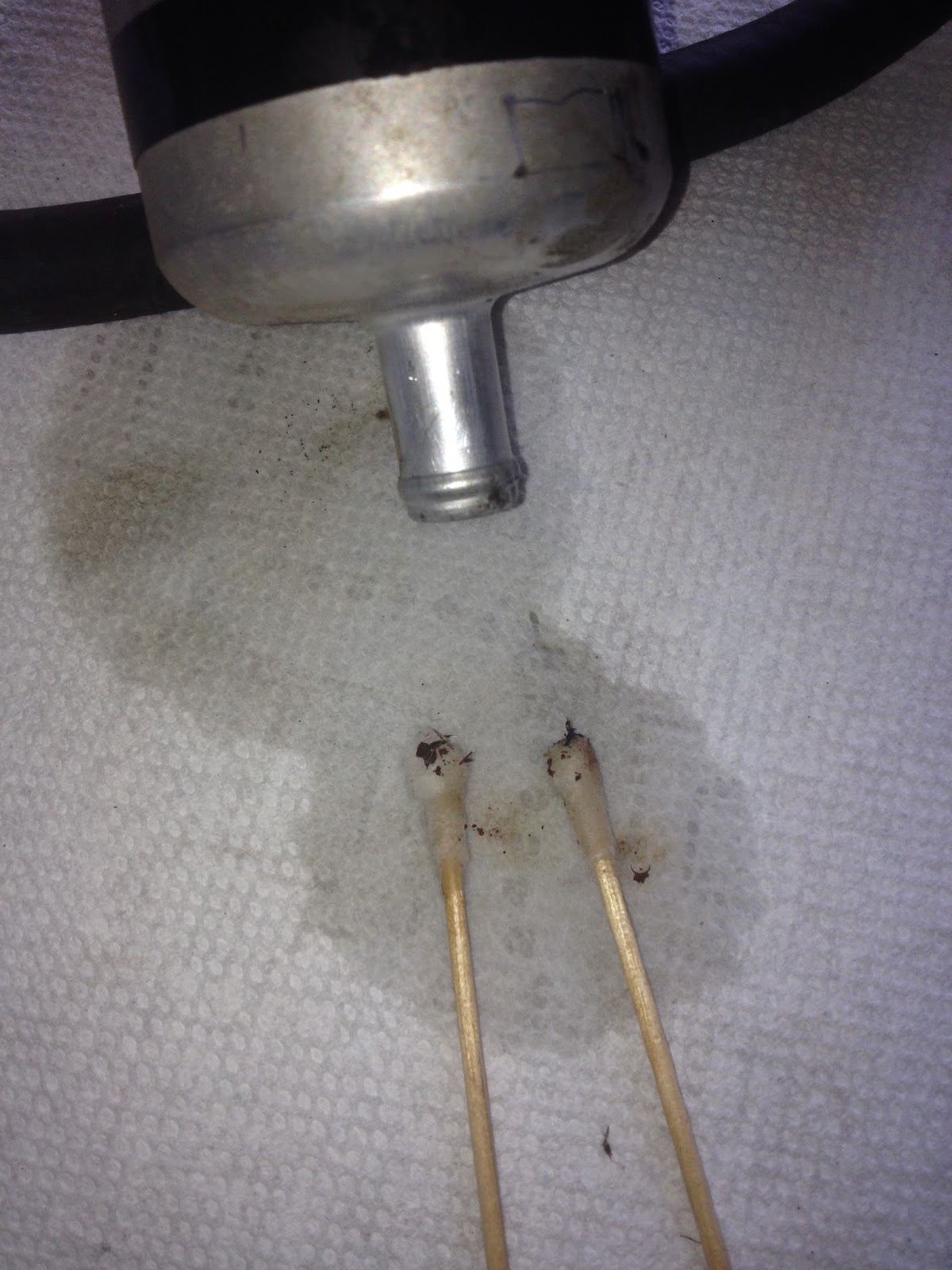
I wondered if that was the tip of the rustberg. I began tapping the inlet of the pump on a paper towel. A horrifying rust mound quickly formed.

I let it rest for a while, then repeated. More rust continued to come out.

So, rust had gotten past the pickup screen and into the E28 fuel pump. I would’ve screamed eureka, but it hardly seemed appropriate. I’d already changed the fuel pump and it made no difference. And the questions. Was the rust from the pre-cleaned gas tank? From a single bad tank of gas after all the work had been done? I didn’t know. I asked Brian about the exact order in which all the known good work had occurred. In fact, it wasn’t all at the same time. In one thrust, the fuel tank was cleaned, and the rebuilt injection pump and cleaned and tested injectors were installed. But the E28 fuel pump was apparently installed earlier. This made some sense. It meant that rust from the pre-cleaned tank could’ve gotten into the screen-less E28 fuel pump and hung out in there, still present even after the tank and injection components were cleaned.
The question was how far forward in the car the rust had gotten. Had the E28 fuel pump acted like a food processor, grinding up the rust and spitting it into the injection system? I removed the main fuel filter by the battery—the one Brian had installed in the parking lot in Virginia, then driven perhaps 40 miles on while nursing the stumbling car to where he could rent a U-Haul trailer and truck. I tapped the filter on a paper towel, and only clear gas came out. Again, this was the replacement filter. The previous filter was the one where Brian reported that “black stuff” came out when he tapped it on a paper towel. Well, whatever had happened had happened, but it was clean now, and there was no evidence now that rust was getting past it into the engine.
Still, I wanted to be thorough, so I used compressed air to blow out the line from the inlet of the filter all the way to the back of the car. Note that this line consists of a hard metal line that runs underneath the car, with a short rubber hose on each end. I captured the blow-out in a bottle.
I was greeted with a horrifying combination of rusty scale, sediment, and powdered rust.
Known good my ass.

I blew the line out probably ten times trying to get it clean, spraying carb cleaner in one end, and using a rag held on the other end with a hose clamp, and still kept getting a faint halo of rust on the rag.

A new mystery presented itself: How could all this crap come out the line, yet none of it be present in the fuel filter? I theorized that, since the tii’s fuel filter is mounted vertically next to the radiator, it was possible that lose crud could come into the filter and get blocked, but when the fuel pump was shut off, gravity could cause the gas and crud to simply drain out the bottom of the filter into the fuel line beneath it, and accumulate there.
I also theorized that there were probably at least three separate issues. The big rust was likely from the original unclean tank or a load of bad gas, whereas this fine powdery stuff I couldn’t get rid of was likely because there was rust forming on the inside of the long metal line itself, as well as inside the metal expansion tank. I blew the metal line and the tank out, individually and repeatedly, and always saw a faint rust halo on the rag.
There was one more fuel line—the return line from the pressure valve on the back of the Kugelfischer pump to the gas tank. I did the same test, putting a bottle on one end and blowing compressed air into the other. This line showed up clean as a whistle. This was good—there was no evidence of rust making the round trip back to the tank. And with no rust coming out of the main fuel filter, that meant there was no direct evidence anything had gotten into the Kugelfischer pump or the injectors. At least not yet.
Finding all this rust may not have deserved a eureka, but how could it not affect the car’s running? How could the car not run better with it all cleaned out? I put everything back together and drove the car.
No difference.
Okay. Okay. There was one more thing to try before zeroing in on the challenging and expensive issues of the Kugelfischer injection pump and the injectors. That was the gas itself. One school of thought is that an additive containing alcohol can break up the water, allow it to mix with the fuel and be burned, but the other school of thought is that, if you have water in the gas, there’s little alternative but to drain the tank.
Rather than wonder about it, I just did it.
Fortunately, 2002s have small (10 gallon) tanks anyway, the tank was less than half full. I took the old E28 fuel pump—the one that had all the rust in it—wired it to a battery, and used it to pump out most of the gas into a gas can. I then manually cleaned the bottom of the tank with rags until it was visibly free of scale and particulate matter. Again, it didn’t really look all that bad to me. It seemed to me likely that the tank had been cleaned, but some load of particulate matter came in, perhaps with a fill-up. But wherever it had originated, I cleaned it up.
For a moment, I thought “you know, now that it’s drained, if I remove a few bolts, I could pull the gas tank completely out of the car and have it professionally cleaned.” But I didn’t know that the tank, or bad gas, was in fact a problem, much less the problem, and I didn’t want to wait a week for the tank to be cleaned and reinstalled to find out. Instead, I drove to AutoZone, bought a brand new clean 5 gallon gas can and a generic high-pressure fuel filter, drove to a branded gas station, bought a few gallons of branded 93 octant gas, dumped it into the cleaned tank, installed the generic fuel filter between the tank and the fuel pump (which was now my fuel pump out of my tii) to reduce the possibility of any stray particulate matter from the tank getting into the fuel pump, and drove the car.
No difference.
My future seemed to ineluctably involve a Kugelfischer injection pump and injectors.
Then I got a call on an unrelated matter from my friend Tom Samuelson. Tom has eclectic car tastes. He has a killer E9 and an E24, but also a beautiful E Type convertible, a Volvo P1800, and a hot rod. Sometimes cooking in a bunch of different kitchens gives you better perspective on problems. I explained to Tom what I’d found.
“Hmmn,” he said, “Kind of sounds like an ignition problem to me.”
“That’s what I thought,” I said, “but the diagnosis hasn’t borne that out.”
“Was anti-seize paste ever used on the plugs?”
“I don’t know. Why do you ask?”
“Well,” he said, “I’ve seen it cause intermittent grounding of plugs, translating into weak spark.
It fit the symptoms. I texted the question to Brian. “You know,” he said, “in fact, yes, I did use anti-seize on the last set of plugs.”
Bingo. And thus we see the value of knowing the difference between “it can’t be an ignition problem” and “I don’t see how it could be an ignition problem.” The latter leaves room for anti-seize paste; the former does not.
I called back Tom. “What do you use to get it off?”
“Acetone and a toothbrush.”
This was perfect. There’s a Rite-Aid next to Bentley Publishers. At the end of the day, I walked next door and bought some acetone nail polish remover and a toothbrush. I could barely contain my enthusiasm as I drove home. I didn’t even head inside the house; I went straight into the garage. I pulled the plugs and cleaned them and the plug holes with acetone. There wasn’t much residue, but, hell, who knows. I cleaned it all up, put it together, drove the car, and…
No difference.
Crap.
Sigh.
I’d always thought that Brian’s worst fear about there being brass screen fragments inside the injection was highly unlikely. Now, even though I still had no direct evidence that any contamination had gotten past the main fuel filter, I didn’t know what to think. There really didn’t seem to be much else it could be other than the injection pump and/or injectors. And whether they’d gotten contaminated by rusty fuel or by screen fragments didn’t seem to affect the course of action. Either way, I needed to look at the pump and injectors.
The Kugelfischer injection on the 2002tii has the reputation of being arcane and impenetrable, but in fact it’s quite well documented. The injection pump itself is often referred to as a Swiss watch of engineering. Back in the day, BMW of North America published a slim volume “The BMW 2002 tii Fuel Injection System” intended for service technicians. It’s available for download on Bob Murphy’s 2002tii site at www.2002tii.org/pump/pump_guide_v1.pdf. The manual largely treats the injection pump as “no user serviceable parts inside,” but, to continue the Swiss watch analogy, there are four small Allen key covers on the top of the pump, and beneath them are four little suction valves that look remarkably like little watch batteries (e.g., sure, pop the back off the watch to change the battery, but don’t even think about touching anything else inside). There are also four delivery valves screwed to the top of the pump. The injection lines are attached to the delivery valves. The manual does a nice job leading you through a rough-running troubleshooting exercise to isolate  the problem to a cylinder, and from there to the suction valve, delivery valve, injector, or, by default fall-through, the pump. It essentially says:
·        First, make sure it’s a fuel problem and not an ignition problem.
·        One line at a time, use a 14mm wrench to slightly loosen the connection of each fuel line to each delivery valve. Fuel should immediately come out the loosened line, and the engine should run noticeably rougher. If it does, that cylinder is probably not the problem.
·        If fuel leaked out but the engine doesn’t run rougher, the problem is likely either the delivery valve or the injector. Swap delivery valves between cylinders to see if the problem stays with the delivery valve or the cylinder. If it stays with the cylinder, it’s likely the injector. Swap injectors and retest.
·        If no fuel leaked out, the problem is likely either the suction valve or the injection pump. Swap suction valves between cylinders to see if the problem stays with the suction valve or the cylinder. If it stays with the cylinder, it is likely an internal problem with the pump.
I went through this exercise and found that, when I cracked open line #4, no fuel leaked out.
A-HA! Finally! Got you, you little sucker!
Following the troubleshooting procedure, I undid #4 Allen key cap and pulled out its suction valve. The underside had a red powdery coating on it. I immediately removed the other three suction valves and checked them. They all looked similar. This appeared to be the first direct evidence that rusty fuel had in fact made it into the injection system. This was big.
(I’m not sure what happened with this photo, but you can still make out the slight rusty cast on the valves.)

Almost giddy with the discovery, but biting my tongue to not shout “EUREKA” and anger The Hack Mechanic Powers That Be, I thought “to hell with swapping #4 suction valve with #3. I’m swapping all four suction valves with the, ahem, known good ones from my tii and driving the car.” I had a moment where I thought “no, don’t do this. Don’t skip a step. And don’t risk contaminating your own injection system with rust.” But I could smell victory. And I reassured myself that I’d thoroughly blown out every fuel line on Brian’s car, and the risk of cross-contamination was negligible.
I swapped all four suction valves with those from my tii and drove Brian’s car.
It made no difference.
Unbelievable. Unfreakingbelievable.
I repeated the “crack the line” test. #4 still had no fuel coming out. If I had a “known good” suction valve in there, by the troubleshooting procedure in the manual, this meant the problem was likely in the injection pump itself.
I felt like I was at the scene of a train wreck. I tried to gather my wits and soak it all in. I started the car, and looked, and listened.
I said that, back when I was checking out the car in the parking lot in Virginia, “I put a finger on each of the plastic injector lines and verified that I thought I could feel fuel pulsing into them.” With this new knowledge about #4 pump line apparently not outputting fuel, the validity of that observation was clearly in doubt. I again put my finger on #4 line. Could I feel pulsing, or was it just sympathetic vibrations from the other lines? I couldn’t tell.
But, then, I saw something. The fuel lines are translucent plastic. And #4 line looked different than the other three. With the car running, I could see nothing in the other three lines, but #4 looked like, well, like when you slurp liquid and air up a straw from the bottom of a glass. That is, I could see what I assumed to be both fuel and air in #4 line but not in any other. It wasn’t right. Plus, how was it that I could crack the nut holding #4 line and not have fuel come out, but see fuel in the line?
It didn’t make any sense.
The fuel pressure in the lines coming out of the Kugelfischer pump is supposed to be very high, about 500 psi. In a “kids don’t try this at home” moment, with the car running, I completely undid #4 line from its delivery valve and watched. There were small upward spurts of fuel out the delivery valve, but it didn’t look like the 500 psi Vesuvius I’d imagined.
Something appeared clearly wrong with the fuel delivery from #4 port of the injection pump.
So much for horses not zebras.
Did I mention that I was doing this for free, in an attempt to change the ending of a story—this story—from “I failed” to “yeah, I kick ass?”
Okay. I’m going in. In the immortal words of Groundskeeper Willie, “Lunch lady Doris, have you got any grease? THEN GREASE ME UP WOMAN!”

(Next week: The Hack Mechanic goes in, and lengthens his list of life’s regrets.)

(copyright BMW CCA 2014. All rights reserved.)

Monday, July 6, 2015

A Funny Thing Happened on the Way to the Vintage -- Part II

As we ended last week’s piece, I was on the way to The Vintage and stopped to help Brian Ach and his wife Michelle in Winchester VA. The day before, Brian’s 1973 2002tii had begun running rough, like a cylinder wasn’t firing, and he wasn’t sure if he could make it the remaining 300 miles to Winston-Salem. He’d spent most of his waking hours out of the past 24 trying to diagnose the problem and nudge the car back into reliable functionality. He found that the screen at the inlet of the Kugelfischer injection pump had a big rip in it, which was weird. He installed a new fuel filter. No difference. He swapped in new spark plugs. No difference. He was very excited when he discovered the part of the ground strap that should go to the body of the car was simply hanging (though the engine ground strap was connected). He bolted it in place and… no difference.
My friend Jose Rosario and I arrived in the Waffle House parking lot where the car was. I donned my keep-the-gas-off-me white Tyvek suit. Brian was on the phone with I don’t know who, saying “Yes, he’s here now, just got here… yes it is pretty cool.” Now, there are few things I find more satisfying than fixing other people’s cars on the road and feeling the love and the gratitude. And, though I’m a pretty laid-back guy, I do have some amount of ego. I mean, I write this column, Hack Mechanic and all that. And, with the Tyvek, I was literally the man in white. Only the white hat was missing for the full-on here I come to save the day image.
But no pressure.
I asked Brian what work the car had recently had. I knew some of this from the recent hail of text messages, but I wanted to hear it all again. He said that the car had had some vexing rough running problems, but they’d been solved. The gas tank, he said, had recently been boiled out, so that was known good; there should be no issues of contaminated fuel from a rusty tank. And the Kugelfischer injecton pump had been rebuilt by one of the five people in the country who do this kind of work (the same fellow who rebuilt mine). The injectors had been cleaned and tested at the same time. All this work had occurred about 700 miles ago, and ever since, the car had been running fine.
 “Fuel pump?” I asked.
“Replaced with an E28 pump at the same time as the other work.”
So it sounded like the entire fuel system was known good.
But then I remembered that Brian said, when he changed the fuel filter yesterday “black stuff” came out of the original one, and that the KFish pump screen was ripped. “Let me see that torn Kugelfischer pump screen.” Brian handed it to me. This is a small screen, about 3/4” long, thinner than a pencil, that sits inside the banjo bolt at the inlet to the injection pump. It’s supposed to be a last line of defense for anything that gets past the fuel filter, which sits right behind it. Sure enough, it had a big rip in it. “Either the screen wasn’t replaced when the pump was rebuilt, which it certainly should’ve been,” Brian said, “or it was, and then something blew through it. My nightmare scenario is that the shreds of the screen got into the injection pump and/or injectors, mucked it up, and that’s what’s causing the problem”
“Well,” I said, “as they say in the medical world, when you hear hoof beats, think horses not zebras. Fragments of the screen jamming or clogging up the pump or injectors certainly isn’t the first thing I’d suspect. One thing at a time. What, exactly, is the symptom?”
Brian talked about a misfire. He’d rev the engine up and ask “Do you hear that?” And I didn’t. At idle, or standing next to the engine compartment and hearing it rev, I didn’t hear anything I’d flag as wrong. But when I drove the car around the Waffle House parking lot, it felt like it was short 50 horsepower. But then, damnedest thing, it would come alive around 3500 RPM. I mentioned that to Brian when I got back from the test drive. “Yeah,” he said, “but it won’t stay that way. On the highway, it’ll keep cutting in and out. That’s why we stopped.”
We talked about the ignition system. It was bit of a hodge podge. He’d originally had a HotSpark coil in, but had swapped it yesterday for a Bosch Blue coil with no ballast resistor (nothing wrong with that), and that change made no difference. Inside the distributor was a HotSpark electronic ignition unit, similar to a Pertronix, that replaced the points and condenser. In addition, there was an odd fat red wire running from the coil back through the firewall. I assumed that meant the ignition relay was bypassed and the coil was wired directly to the ignition switch. The distributor had not been rebuilt, at least not that Brian was aware of. I wanted to bring down a spare dizzy, but the only known good one I had was in my tii, which was not at my house when I packed the Bavaria and left the previous day, so I had no spare with me, a situation I would come to regret.
“Plugs?” asked.
“Just replaced them yesterday,” Brian said. “NGK BP6ESs.”
“Right,” I said, “forgot about that. Plug wires?”
“Brand new from Ireland Engineering.”
“Okay, so known good.”
“Yes, certainly should be.”
I pulled off the distributor cap and carefully inspected it. I found no cracks or evidence of carbon tracking.
I had Brian crank the engine while I held the wire from the coil 1/4” from a convenient ground. I saw a strong steady spark.
I took my advance timing light (what, doesn’t everyone travel with an advance timing light?) and did a quick check of the ignition. Some kind soul had painted a timing mark on the front of the crankshaft pulley (the one on the flywheel can be very challenging to see through the little window in the bell housing). The mark advanced like it should with increasing engine rpm. I set the advance on the light to 25 degrees and had Brian rev the engine to about 2500 rpm. The mark lined up fairly well with the fiducial on the cover. I then set the advance to 32 degrees and had Brian kick the engine to about 4000 rpm to check for total advance. Again, the marks lined up. Nothing was amiss with the advance function of the distributor, at least nothing obvious.
I used the timing light to check for consistent spark. First I put it on the wire from the coil to the center of the dizzy, and had Brian rev the engine to where he heard the misfire. The light shined steadily. I then put it on each of the four plug wires. On one plug wire, I had a moment where the light didn’t flash, but I never got it to repeat, and it wasn’t correlated with the misfire that Brian heard. So nothing was wrong with the ignition system, at least nothing obvious.
The day before, while trying to help Brian troubleshoot over the phone, I’d asked him if he had points with him. He didn’t, so I came down with known-good points and condenser—the last ones that had been in my tii’s distributor before I put a Pertonix into it. Not a week before, I had put a brand-new Pertronix into my Bavaria, only to have it lose power at high rpm, and work perfectly fine when yanked the Pertroix back out and put the points and condenser back in. At a loss for what else to try on Brian’s ignition, I pulled out his HotSpark electronic unit, swapped in the points and condenser, gapped the points, and spun the car around the parking lot.
No difference.
Nothing was obviously wrong with the ignition system. At least nothing else I could test without having a whole known-good distributor with me. Did I mention I would come to regret this?
Okay, well, then, back to fuel. I took the fuel pressure gauge I’d brought with me and spliced it into the fuel line with a tee. The fuel pressure, both static and running, was about 24 psi. That’s a little low; it should be 29 psi. But low fuel pressure usually manifests itself as problems at high rpm, since the need for fuel increases with engine speed. This car was having the opposite symptom; it stumbled at low rpm and seemed to come alive as the rpm increased.
I put a finger on each of the plastic injector lines and verified that I thought I could feel fuel pulsing into them.
I opened up the “tuna can” at the top of the injection manifold. CCA member Jim Gerock once had a maddening stumble that turned out to be due to a combination of the small spring in the tuna can having come loose, coupled with ignition advance problems. The spring was fine. I pulled on the throttle linkage and verified that the shaft rotated smoothly and caused the cam in the can to kick the throttle open without binding. It all looked fine.
I checked the integrity of the injection linkage rods. There was a lot of play between the gas pedal and the linkage, as there often is, but the important rods, the ones that connect the injection pump with the throttle body were tight. I pulled out my tii tools and did a quick check that the cam in the can aligned with the synchronization hole in the can when the injection pump was “pinned” at the first slot. I visually verified that the piston in the warm-up regulator extended until the so-called “verboten” screw sat against its stop. It was fine, as one would expect of a pump and warm-up regulator freshly rebuilt by one of the professionals in the field.
I pulled the pressure regulator valve off the back of the injection pump. This has a small orifice in it through which fuel must pass on its return trip to the gas tank. This effectively sets the system fuel pressure. I visually confirmed that the orifice was clear.
For grins, I put a penny between the “verboten” screw and its stop. This has the effect of moving the pump’s enrichment lever, simulating the car still being in warm-up, which enrichens the mixture. I drove the car.
No difference.
Jose and I had been there for over two hours. I still had nearly 300 miles to go before I slept (yes, that is a Robert Frost reference). I was running out of ideas. I pulled the fuel filter out—the one Brian had just installed—and drained it into a paper towel. All that came out was clear gas. I rotated the engine to top dead center, pulled off the front plastic injection belt cover, and checked the timing mark on the Kugelfischer pump. It was correctly aligned.
Like the Grinch, I puzzled and puzzled until my puzzler was sore.
So I used my Lifeline. I called Paul Wegweiser, who was already down at The Vintage. He was aware of the general situation with the car, as the thread I’d started on Facebook the night before had been updated by Brian. I described everything I found to Paul. He was most interested in the fuel pressure.
“Well,” he said, “talking it over with the brain trust down here—all of whom, by the way, refuse to be identified by name—the consensus is: Put a fuel pump in it and see what it does. Yes, 24 psi isn’t awful, and you’re right, it doesn’t exactly fit the symptom, but it should be 29 psi. Places like AutoZone and Advance Auto Parts may well carry Bosch-branded E28 fuel pumps.”
As this advice was coming over the speaker in my phone, I looked over and saw that Brian’s wife Michelle was on her iPhone, quietly locating the nearest AutoZone and AAP.
I have been remiss in not talking about Michelle. In a way, Michelle is the whole story.
The way that spouses and their significant others handle this sort of situation is a microcosm of their entire relationship. We now live in a post-marriage-equality climate (yay!), but most of the car-cursed couples I know are men and women, so I’ll talk about men and women.
Let’s be honest. Men often go over the edge in terms of the amount of money and time they devote to cars, don’t know when to stop, and cause stress in their relationship with their spouse. Spouses can react to this in a whole variety of ways. The caricature of this is the wife, hands on her hips, shrilly declaring when will you admit that you failed and call a tow truck? Enthusiast forums are full of car-died-on-trip-with-wife-or-girlfriend stories, some of which describe this exact situation, and all you can do is cringe and say ”jeez… glad I married the right girl.” At the other extreme, some of us are blessed with spouses who are nothing but supportive, reasonable, in it for the ride along with us, and share both our triumphs and our pain. Michelle clearly was one of these spouses from heaven, and she and Brian clearly had the kind of relationship that Maire Anne and I have.
After a few phone calls to auto parts stores, Brian learned that there were no fuel pumps in stock nearby, but that one could be had the next morning. He asked me what I thought. This was a slippery slope. I was going from trying to repair a car to giving advice. Sometimes advice is more dangerous. “Well,” I said carefully, “the fuel pressure is low, and there’s no harm in trying, but it doesn’t fit the symptoms, so I think it’s less likely rather than more likely that it’ll solve the problem and send you on your way.”
It had only been three hours for me, but it had been 24 for Brian. With this advice, he officially passed from resigned to crestfallen. “You know,” he said, “I always wanted a tii. I bought this one, and it’s been a boatload of trouble. Every time I think I’ve sorted this running problem out, it comes back and bites me. I’m wondering if I’ll ever see the end of it and be able to trust the car.” I tried to talk him down from the ledge, but he was clearly frustrated out of his gourd. I tried to give him perspective a few troubleshooting stories, and how you’re so often robbed of that classic “eureka” moment because, after you’ve been working for days, when you finally find it (if, indeed, it even is an “it,” as opposed to a collection of problems), the response so often isn’t “eureka,” but instead is “that was the problem? That was ‘it?’ That’s so stupid!”). But, one way or another, all of these problems are, in fact, solvable.
At about 3:30pm, with six hours of driving left ahead of me (and I hate driving after dark, particularly at the end of 14 hours at the wheel), I had to call it. And it broke my heart. Brian and Michelle were saying “Go! You’ve done enough!” And, to be clear, it’s not like I was leaving them by the side of the Jersey Turnpike. The Comfort Inn, where they’d spent the night, was right next door. And the car ran—they could go out for food and supplies—just not well enough to risk the trip all the way down to The Vintage and back.
Brian put a good face on it. “I bet you’re going to write about this, right?” he asked.
I winced. “Yes,” I said, “but it’s the wrong ending to the story.”
As Jose and I prepared to leave, Brian asked me something. “Think about this while you’re driving, if you can,” he asked. “What would you do, and how would you fix the car?”
I didn’t quite understand the enormity of the question. Brian clarified.
“First,” he said, “I have to figure out a game plan. I can either get the car home, or try and have it fixed locally. I can call AAA and have them recommend a vintage foreign car repair shop, but… if you couldn’t fix it, if you couldn’t even figure out conclusively if the problem is gas or spark, what are the odds that some non-tii-specific shop that AAA tows it to is going to diagnose it correctly and fix it once and for all so I can actually drive it home?”
My ego notwithstanding, he did have a point.
“And,” he said, “once I get it back to New York, I’m going to need to get it fixed. The guy who did all the recent work obviously missed something. Or something really weird has broken. So,” he asked, “I’m asking you to think… if it was your car, how would you diagnose and fix this problem?”
It was, in fact, a great question.
We said our goodbyes, and Jose and I headed south. To say that I continued to be preoccupied with the problem was putting it mildly.
About 10 minutes into the drive, I had an idea. Voltage! I didn’t check voltage! I was thinking about what could cause the symptom of rough running at lower rpm that smoothed out as rpm increased. If the alternator and voltage regulator weren’t outputting the requisite 14.2 “charging volts” until some higher rpm, then the ignition would be running off lower battery voltage—more like 12.6—until the alternator and regulator cut in. It was slim, but it might fit the symptoms. I had a voltmeter with me, but didn’t think to try it. Plus, there was that strange thick red wire running to the coil. Maybe there was a basic voltage delivery problem to the ignition. Damn! Should I turn around? I called Brian and told him the idea. He didn’t have a meter, but I explained that they’re pretty cheap these days ($5.99 at Harbor Freight, maybe $20 at an auto parts store), but that this was a low-probability thing, just something to try. He thanked me for the advice, but said he was already trying to line up a U-Haul truck and trailer to haul the car home.
The rest of my trip continued without incident. Jose and I arrived at The Vintage after dark. Many attendees were already aware of the story of Brian’s car via the Facebook posts and my conversation with Paul. Whenever anyone said “you were so good to try and help,” I’d just get this pained expression on my face. I’d failed. I didn’t want to tell this story. I wanted to tell a different story, the one where the guy in white figured it out and actually helped them get here.
While at The Vintage, I hung out with Ben Thongsai. I described the problem to Ben (who, you have to remember, heals cars with his mind), and he said, without an ounce of ego or swagger, “you should’ve had him tow it down here. We’d be able to fix it.” I winced a little. “That’s not a recommendation I felt that I could, in good faith, make.” He understood.
There was a very nice moment on Saturday. Bo Gray, one of the event organizers, found me and explained that this year they were presenting something new, the A Funny Thing Happened on the Way to the Vintage award (a sculpture made from one of the pistons that tried to fly out of Bo’s 3.0CS engine when it failed last year) to be given to the person or people who suffered the greatest degree of hardship getting to, or trying to get to, the event. He asked what I thought about presenting it to Brian Ach.
“Give it to Brian and Michelle,” I said. “She was off the chart awesome.”
“Done,” Bo said, “except… could you accept it in their absence?”
I nearly cried.
By that evening, Brian and Michelle had seen the photos on Facebook of me accept the A Funny Thing Happened on the Way to the Vintage award on their behalf. They were now, officially, part of the event that they weren’t able to come to. That was the highlight of the trip.

During the entire 14 hour drive home on Sunday, I was utterly preoccupied. I thought about Brian’s question “If it were your car, what would you do to fix it?” The answer to that was actually pretty clear. I have the identical car (well, nearly—’72 instead of ’73). I’d narrow it down as spark or fuel by driving my car, verifying it ran okay, then transfer over the entire known-good ignition system—dizzy, Pertronix, cap, rotor, coil, resistor, plug wires, plugs, everything—into Brian’s car. If the problem went away, it meant it was an ignition problem, and I’d swap Brian’s ignition parts back in until the problem reappeared. If the problem did not go away, it meant it was likely a fuel delivery problem. Since the fuel tank, fuel pump, injection pump and injectors were all known good, I’d go through it systematically, pulling injection parts, including the Kugelfischer injection pump if necessary, out of my own car and swapping them until the problem went away.
Over the next week, I realized something. Having figured out the approach, I was, in fact, in a unique position to apply it and solve the problem. In other words, I had the power to change the end of the story. What repair shop has a tii and would be willing to yank an entire ignition system, injection pump, and injectors out of it and swap it in?
I said to Maire Anne “I’m going to offer to Brian that I come down to NY in my tii and swap parts until we figure it out.”
“I’m not at all surprised,” she said. “I knew you wouldn’t be able to let this go.”
God I love this woman
I called Brian and made the offer. I felt we needed a weekend; a single day wouldn’t be enough. He was grateful beyond words. We tried to line up a weekend, but we both were busy.
So I offered Plan B: Get the car to me up in Newton and I’ll fix it for free, parts only. The more I thought about it, it had advantages over Plan A. I didn’t need to drive back and forth to NYC. And I’d have the car in my garage, with my tools and parts. Who knows, I said; I might need to do something that would be hard to do in someone’s driveway in the city, something like draining the gas tank. I didn’t think it might actually come to that. And I certainly had no clue whatsoever that, if that was the worst of it, it’d be cake.
I floated this all on Facebook and on bmw2002faq.com. I explained the history of the problem and what Brian and I tested in the parking lot. I offered a work plan and solicited suggestions. I was trying to crowd-source all the knowledge I could. Comments poured in. I incorporated them into my work plan.
On Saturday, June 13th, Brian’s beautiful Agave ’73 2002tii arrived in Newton, transported in a small trailer by a delightful man named Jay Kapoor, with whom I jawed for at least an hour. I then brought the car into my garage and began working on it.

The Great Change the Ending of the Achmobile Story Project had begun. I was soon to find that the original story contained a mystery. Hell, a mystery wrapped in an enigma inside a conundrum. And in order to change the ending, I had to solve the mystery. And that proved way more challenging than simply swapping components.

  (Next week: What the hell did I get myself into?) 

(copyright BMW CCA 2014. All rights reserved.)

Tuesday, June 30, 2015

A Funny Thing Happened on the Way to the Vintage -- Part I

Some of you may be wondering what the story is surrounding the fact that I haven’t written about my annual pilgrimage to The Vintage, the wonderful “a gathering, not a car show” that occurs annually around Memorial Day in Winston-Salem and traditionally occupies several columns and feature articles.
Let me say that there is A Story. Oh is there ever A Story. It just didn’t have the ending I wanted. And so I forced The Story to reboot itself until it bent to my iron will.
Like all good stories, it starts at the beginning.
I was going through my usual machinations about which car to take to The Vintage (which is one of the happier problems in my world). It’s an 800 mile drive each way from Newton, 14 hours on the road. After five years, I have it down to a science—leave at 5 am, pound out the miles, arrive in theory at 7 pm while the sun is still up (at age 56 my ability to drive after dark, particularly after 14 hours, is limited). Two years ago I took my beautiful 3.0CSi for the third time, and hit 500 miles of drenching unrelenting rain. It was so far over the line of what I ever wanted to expose the car to in terms of water—my entire 30 year quota of ownership moisture used up in a single trip, with a credit taken against the next 30 years—that I’ve been gun-shy ever since about taking the coupe on long trips where there is even the remotest possibility it might rain.
I thought about taking the 2002tii, as it has never seen The Vintage (though it did do the long trip to MidAmerica 02Fest last year), and even entertained driving the air conditioning deprived 1979 Euro 635CSi but in the end, I opted to take my Bavaria again, as there are so few of them at The Vintage, it’s so comfortable to drive, and it’s just so damned much fun. I could write several columns about the preparation of the big Bav (for example, I looked at the dwell, saw it was 58 out of 60 degrees indicating that the points were barely opening, the points were pitted garbage, I ordered a new Pertronix, installed it, the car labored to rev over 4500 RPM, I yanked the Pertronix out and put new points in), but by Wednesday of game week the Bavaria and I were ready to go.
As is the case with many hair-brained things I do, there was a thread on all this on Facebook. I began talking with several other northeasterners about caravanning down. Unfortunately, with my full-time responsibilities at Bentley Publishers making me a working stiff again, I was looking at not driving down Thursday like I’ve always done, but Friday. That makes for an upside-down ratio—drive all day Friday, enjoy the event Saturday, drive all day back Sunday—but it was the hand I was dealt this year. As my plans solidified, other saner potential traveling companions dropped out. It was looking like it’d be only me and my friend/customer Jose Rosario.
But on the Facebook thread, one fellow, Brian Ach, chimed in. He lived in New York City, and had a ’73 2002tii he’d bought a few years back. The car had a history of rough running issues. He thought he was finally through the other side of them, and had put 700 trouble-free miles on the car since a big round of repair work. He and his wife Michelle were prepared to drive the tii to their first Vintage, but wanted the safety in numbers of a caravan, the automotive equivalent of herd immunity. Could we meet up with him, he asked, at a certain Starbucks after the Tappan Zee bridge in New Jersey off 287? I determined that if I left my house at 5 am, we’d get to this rendezvous point at about 9:30. The plan was in place.
On Thursday morning, I was at work when I got a text message. It was Brian. It was 9:30. “I’m here at the Starbucks. How far out are you?” it said. cuttinI’m leaving Friday! IT’S ONLY THURSDAY!” This is the downside of too many avenues for communication. There had been Facebook messages, text messages, and an e-mail thread, and the fact that I was always talking about departing on Friday was at the bottom of one of the three of those he hadn’t read closely enough. We both had a good laugh over it. He said that although he’d prefer to be part of a caravan, he was launched and committed, the tii was running well, and he and Michelle were on route. “See you down there Friday, then,” I said.
The trouble started several hours later. I got a text message from Brian, then a phone call, saying that the tii had begun running rough, missing and sputtering, acting like it was short one cylinder until about 3500 rpm, at which point it came alive but continued to cut in and out. He and Michelle were off I81 near Winchester VA in a parking lot between a Waffe House and a Comfort Inn. Through a hail of texts, phone calls, and Facebook messages, I and others tried to remotely help him trouble-shoot the car. He said a few times that he wasn’t a mechanic and wasn’t intimate with the tii’s injection bits, but he was selling himself short; clearly he knew his way around cars and tools, and had owned and maintained other interesting enthusiast cars, including a Miata, a 914, and an M3.
“Cars, particularly tiis, that act like they’re running out of fuel, usually are,” I explained. There are three fuel filters—the tomato paste-sized canister near the battery, a small cylindrical screen at the inlet of the Kugelfischer fuel injection pump, and another small screen at the inlet of the fuel pump beneath the car. If there’s crud in the gas tank, the fuel pressure shoves the crud up against the screens, eventually lessening fuel flow enough to starve the engine, making it feel like it’s running out of gas, which, really, it is. I asked if the problem was cyclical—did it get worse as he drove the car, but then lessen if he parked it for 10 minutes which allows some of the crud to sluff off the screen, only to repeat the cycle when driven again? This is the textbook manifestation of the crud-on-the-screens fuel starvation problem. “Not exactly,” he said, “it’s just bad all the time. And worse at low rpm.”
That last piece was unusual. Fuel starvation problems are usually worse at high rpm, where engine demand for fuel is highest. Perhaps it was an ignition problem, not a fuel problem.
Plus, Brian, explained, he’d had the gas tank boiled out not 700 miles ago, so that was known good; the root cause couldn’t be rust coming from the tank. And the fuel filter by the battery was new.
Even though the symptom didn’t fit exactly, I talked Brian through looking at the screen at the inlet of the Kugelfischer pump. 10 minutes later he texted me a scary photo. The screen wasn’t clogged with crud, but it had a big shredded slice down the middle of it. It was the first of several mysteries.
Brian removed the main fuel filter from next to the battery, and tapped the inlet side out on a paper towel. He reported that a lot of “black stuff” came out. He had a spare filter with him and installed it. How this jived with the tank supposedly having been boiled out was unclear. But, unfortunately, after replacing the fuel filter, the problem persisted.
We began talking about the ignition system. He had a new spare set of plugs with him. He installed them, and it made no difference. The car had some combination of a HotSpark coil with no ballast resistor, and a HotSpark electronic ignition module. He said he had a spare Bosch Blue coil with him. He installed it. No difference.
I posted Brian’s plight on the Vintage Facebook page, describing where he was in northern VA and the symptoms of the problem he was having, and exhorted folks to help him if they could. Suggestions poured in.
It was now about 4pm on Thursday. “Well,” I said, “if you’re still there when I pass by on my way down tomorrow afternoon, obviously I’ll stop and help you. I’m driving my Bavaria. It’s got a big trunk. I’ll throw in some 2002 parts.” He laughed. “Michelle and I certainly hope we’re not still here by that time tomorrow,” he said. But, by the end of Thursday, I got a text saying that he and Michelle had holed up in the Comfort Inn for the night. I packed the Bavaria with even more tools and parts than I’d normally bring, basically every spare 2002 ignition and injection bit I could stuff in without actively cannibalizing my own tii. Unfortunately I could not locate a good spare distributor, a fact that would come to haunt me.
On Friday morning, I left Newton at 5 am, rendezvoused 45 minutes later with Jose at a service plaza on the Mass Pike. Our caravan of two headed west, then south. Winchester VA was nearly 600 miles from Newton, about 9 hours at the wheel with short breaks and no traffic. I was in periodic contact with Brian, who was throwing everything he could think of at the car, to no avail. “For me to stop and help you, I need to know your exact address,” I texted several times (voice dictation is a wonderful thing while driving), but in the heat of the moment, he kept texting back status updates but no address.
Then, my Verizon cell service went dead. I later learned that there is, in fact, a known Verizon dead zone along this part of I81, but it was very strange. I was rapidly approaching Winchester, and I had no address. Finally service came back on, and a text message from Brian came through with the exact address of the Comfort Inn. I clicked on the address and found I was only 10 minutes away. Sheesh. That was close, literally.
Jose and I pulled into the parking lot of the Comfort Inn but didn’t see the car. Then we saw a gentleman come running out from the parking lot of the Waffle House next door, waving his arms. We looked left, and there was the tii. The Bavaria pulled up next to the tii, which was sitting, hood open, with tools arrayed in front of the trunk like that photo on the back of Pink Floyd’s Ummagumma album showing band equipment laid in front of their tour bus (intended to look huge in 1969, but laughably quant by modern standards).
I opened my trunk, which seemed to automatically began disgorging the stuff I needed. I donned my white Tyvek suit and nitrile gloves. Brian was on the phone with someone. I overheard him say “Yes, he’s here now, just got here… yes it is pretty cool.”
If you think don’t I enjoy the image of being a white-hatted (or, literally, white-suited) savoir, you don’t know me very well. I have very little pride or shame, and I admit my mistakes more readily than most, but I do have some amount of ego.
I then had several hours in which to try to live up to my own and other people’s expectations.
(Next week: The parking lot surgery begins.)

(copyright BMW CCA 2014. All rights reserved.)

Monday, May 11, 2015

Hank the Car Guy

When we moved out of my mother’s house in Brighton MA nearly 25 years ago to the tony suburb of Newton (I’m joking about the tony part; I live across the street from a landscaper and his chorus of leaf blowers), our new next door neighbors Hank and Jeanette, a retired childless couple, seemed like nice folks. Hank introduced himself with a smile, laughing “some folks call me ‘Hank the crank.’” Didn’t seem like much of a crank to me.

But with an introduction like that, it shouldn’t have surprised me when the other shoe dropped. It’s difficult to say exactly what triggered the turnaround. It appeared to be some combination of educational resentment (he began calling me “college boy”), the number of cars passing through my hands, and my working on them in the driveway, as the ’73 3.0CSi occupied the precious but decrepit space inside my rusty leaning corrugated metal single car garage. Perhaps Hank was concerned my activity was lowering his property value. Or perhaps I’d transgressed an unwritten law about parking opposite his house. His land yacht of a Lincoln Town Car did appear to need the extra clearance and turning space when he’d back it out of his driveway.

Things got bad. He appeared to watch the registration and inspection stickers on my cars, and would call the police on me if, during my first spring drive in the 3.0CSi, either of the stickers had expired over the winter.  When I prepared to replace the garage, the animosity erupted into all-out warfare, at least on his end. I wanted to build a nice, new, larger structure where the old one was, but since the old one was one foot from the property line, I had to apply for a variance. As a lifelong Newton resident who knew a lot of people, Hank seemed to be the invisible hand behind a rubber stamp denial. “No one needs a garage, and no one needs one of the size you’re proposing,” solemnly intoned the head of the committee who rejected my application. Clearly not a car guy, I thought. The same could be said of Hank. What could someone with a Town Car–the poster child for floaty suspension and same-day steering–know about my passions?

As it happened, the variance denial was a gift. It forced Maire Anne and I to rethink the plans, and we wound up building a larger garage that didn’t need variance approval. When my friend and contractor Alex showed up with the building permit and a backhoe and started to dig, Hank was apoplectic. When Alex accidentally knocked down a section of his fence, Hank came out of his house, red-faced and screaming, threatening to call the police. Alex thought Hank was going to have a heart attack, burst an aneurism, or both. After that, I don’t think Maire Anne or I spoke to either Hank or Jeannette for ten years.

But time softens us all. Hank and Jeannette are now elderly. About five years ago I began using my snowblower to clear their sidewalk in the winter. The first time I did it, Hank opened up his front door and yelled “Robby!” I thought, what, he’s going to chew me out for this? Then he said “It’s been hard for me to deal with the snow since I’ve been sick. Thank you so much!” I kept doing it. The relationship thawed. At the end of each winter, they’ve given me a card and a small gift.

Last spring, they called me over and showed off the new Honda Accord they’d just bought. They seemed to want my approval. “Very nice… Honda builds a great product,” I said. Then I noticed their driveway was empty. “Did you trade in the Lincoln?” I asked. “No, it’s in the garage,” Hank said (they still had the same one-car corrugated metal structure I’d torn down). “But, we were thinking… maybe it’s time we built a two-car garage to hold it and the Honda. Do you think your contractor friend might be interested in doing the work? What was his name... Alex? He seemed very nice.” I almost choked on the irony.

Late last fall, I noticed I hadn’t seen Hank around in a few weeks. I asked Jeanette what was up. “Oh,” she said, “you didn’t know about the accident?” She then told me the following story. Hank had become quite frail, with signs of advancing dementia. He wanted to go for a Sunday drive in the Lincoln, but Jeanette thought that wasn’t the best idea. They compromised and had her brother drive. But as they were pulling out onto Rt 95, they were sideswiped by a tractor-trailer. The car got spun completely around, then was hit on the other side. The car’s occupants were banged up but okay. The Lincoln, however, was totaled. As Hank’s cognitive skills continue to degrade, Jeannette explained, he keeps asking about the Lincoln, not accepting that it’s gone, wanting to see it and drive it again.

“He loved that car,” Jeanette offered. “It only had 20,000 miles on it. People were constantly offering to buy it from him.”

As she was explaining, it all came into focus. He’d probably bought Lincoln the year we’d bought the house. He always garaged it. He had vanity plates on it with his initials and his birth date. The guy I was at war with for all these years was, in his own way, a car guy. How could I have possibly missed this?

I can only hope that, in dementia’s meandering path, Hank he finds a nice new garage, and in it, his beloved Lincoln, and enjoys one more Sunday drive on a perfect fall day.

(Copyright Roundel Magazine, 2015)