Sunday, April 19, 2015

Fitting the Risk, Risking the Fit (part 1 -- the purchase)

Our silver 2008 Honda Fit Sport 5-speed got totaled in mid-March. Painful. Everyone's okay. Don't ask.

Both Maire Anne and I loved this car. We didn't buy it new, but it was the newest, lowest mileage car we'd ever owned. It was our first post-minivan. Two of our three kids were out of the house. It took a little convincing of Maire Anne that she no longer needed a minivan's seating for seven, but once she drove the go-cart little 5-speed Fit Sport, she was hooked.

We bought it in 2009. Fuel had shot up to $4.50/gallon. The folks who owned it had a big SUV whose fuel bills were eating them alive. They bought the Fit and parked the SUV. The wife swore she'd drive a stick. She never warmed to it. Then, gas prices fell, they returned to driving their SUV, and sold the Fit to us.

The combination of the Fit's four doors, hatchback, and the car's "magic seats" (a very low flat floor coupled with seats that also folded very flat) made for a remarkably flexible interior configuration. For Maire Anne's Bugworks business, she carries a set of stackable plastic containers perhaps half as high as a file cabinet, and they have to be kept upright. We used to bungie cord them in the rear of my BMW wagon. But, as it turns out, one of the Fit's seating configurations allows you to fold one side of the rear bench seat up, exposing the floor and creating a space just the right size to hold the bug box without needing to strap it in. She instantly loved it. Sometimes you can't research or predict the things you'll find the most useful or engaging.

The Fit was everything you'd expect a Honda product to be. Absolutely nothing went wrong in 60,000 miles. And it was just a blast to drive. I don't like big heavy cars. I like small, light, and snappy. And the Fit Sport 5-speed was all that. We both loved it. Maire Anne would often say that if anything happened to the car, she'd want another one just like it.

And then, without warning, it was gone.

The insurance company gave us what I thought was a fair settlement -- $8300 including sales tax. Following Maire Anne's wishes, I immediately began looking for another. I quickly found what was as close to the same car as possible -- a silver 2008 Fit Sport 5-speed, 48,000 miles, at a local Lexus dealer, asking price $9800. I thought I was done. I showed the ad to Maire Anne. Her eyes welled up. "I can't buy another one the same color," she said. Heard and understood.

Okay, if it's not this Fit, then we enter "The Process." Now, there are basically two ways to buy a car. There's the way I imagine most normal people do it, which is they wait until they need a car, then go into a dealership and come out several hours later with an actual car that they can actually drive home and actually use later that day. At least I assume that's how it's done.

Of course, that's not what I do. I embark on a long and torturous process that involves solving partial differential equations for constrained extrema in my head and reading the entrails of a goat to find the knee in the curve of price, mileage, and distance. That is, local cars are incredibly convenient, you can go look at them and bring something home easily, but if a car is truly a smoking deal or if it's got a particularly rare option package but it's a thousand miles away, you figure out how to make it happen.

eBay, AutoTrader, cars.com, and craigslist were all brought into The Process. Initially I looked at buying what the insurance check would roughly pay for, but I allowed a certain amount of mission and price creep and began looking at lower mileage cars for more money. After all, the purchase and ownership of our Fit went perfectly. The idea of another trouble-free five years with one of our cars was damned appealing.

I found what seemed to be The Car -- a 2012 Gen2 Fit (they were redesigned in 2009, and again in 2014), right here in Newton. A red base model Fit (not a sport) 5-speed with 27k for an asking price of $11,900. I felt certain I'd buy it on the spot. I checked it out. The seller said he'd take $11,500 for it. But when I drove it... meh. It didn't have the snap that ours had.

I went home and did a ton of reading. The Gen2s are about 4" longer than the Gen1 Fits, so you do lose a little of the short wheelbase snappiness, but in general, people weren't complaining about it. In fact, most reviews seemed to feel the Gen1 cars (2007 and 2008) were a bit buzzy, and the Gen2 cars (2009 through 2014) were quieter and slightly more refined without losing any of the fun. I wondered if the difference I felt wasn't Gen2 versus Gen1 but instead was Sport versus Base. I spent a delightfully anal retentive hour online looking at Honda parts catalogs and figured out that, in terms of suspension, the base and Sport Fits shared the front springs and sway bar, but that was all. The Sport had different rear springs, different shocks and struts, and a rear sway bar where the base had none. And larger wheels and tires. Plus, other non-handling things like much better seats, a much better sound system, and rugs instead of rubber floor mats. And the front and rear spoilers and the side cladding. I resolved to get us another Fit Sport.

When you do these nationwide searches, you find that many of the cars, particularly the ones on Autotrader and cars.com, are at dealerships. You can look at dealer reviews online and check out BBB ratings and factor that into your calculus. I'm a pretty understanding guy. When I see reviews like "we bought this beautiful BMW with 80,000 miles and six weeks later it was leaking coolant everywhere and they wouldn't stand behind it these guys are just awful," I think what the hell did you THINK would happen with a BMW with 80k on it - a used car dealer isn't responsible for that unless you bought an extended warranty through them. And awful dealer reviews don't necessarily cross a car off my list, particularly if the car is out of warranty and has a rare option package I desire. But when you read ten reviews that say "we drove for six hours to pick up a car we had a deposit on but when we got there they'd sold it and tried to sell us something different," that's a pretty clear big flashing red light if the car you're interested in is 500 miles away.

And then there's the whole Carfax / salvage title thing. On sites like Autotrader and cars.com, many but not all dealerships post the Carfax so you can see the title is clean. But then you'll see a car priced 20% less than others with comparable mileage, and there's no Carfax. So you order it (I have someone I found online to whom I pay $5 a whack for Carfaxes) and find out that, of course, the car had been totaled and now has a rebuilt title. Now, this in and of itself isn't necessarily a reason to reject a car (much more on this below). But the fact that it wasn't disclosed and you had to hunt for it is, in my book, an automatic fail. If the dealer wasn't candid enough to admit the car has a rebuilt title, you're very unlikely to find out what the reason was for the salvage title in the first place. Hail or theft damage, maybe not a big deal. Flood damage, you're assuming a boatload (heh) of risk.

But I kept looking. I made a spreadsheet of cars, their VINs, the mileage, price, color, how far away they were, and the reputation of the dealership so I could keep it all straight.

And then, on Thursday April 2nd, I stumbled into a blue 2013 Honda Fit Sport 5-speed on eBay with 9,317 miles for an asking price of $10,999. That was a very appealing set of parameters. But a) it was in Charlotte NC, not easy to run and look at, and b) it had a rebuilt salvage title. However, the seller freely admitted it had a salvage title, and the original damage seemed minor. You can still see the auction here:

http://www.ebay.com/itm/141622846264?_trksid=p2057872.m2749.l2649&ssPageName=STRK%3AMEBIDX%3AIT

The seller had a business rebuilding salvage cars. He said that the car had been hit in the left front wheel and suffered no body damage.

The mileage and cost were incredibly appealing, so I began to look more into the whole salvage thing. It seems to work like this. 

If a car has an insurance claim against it for more than 3/4 of its value, the insurance company will declare it a total loss. This is the origin of the phrase "totaling a car." But, these days, it's damned easy for a car to reach that threshold, particularly if it's an inexpensive car. Folks tell me that any front end impact that bends sheet metal, messes up the suspension, and blows the airbags is generally enough to do it. But cars are also totaled due to theft, vandalism, hail, water damage, and other reasons. The point is, the scarlet "S" is issued on the basis of some insurance adjuster's judgment of the ratio of the cost of the repairing the damage to the value of the car, not on the basis of whether the car is "repairable" in any absolute sense. The car is then sold by the insurance company. When it is sold, it is issued a salvage title. Salvage cars are advertised on web sites like salvagebid.com which typically list a gross classification of the reason the car is there ("front collision," "burn," "recovered theft," "flood," etc) and walk-around photographs of the car. Businesses and individuals may then bid on and buy the salvage car and repair the damage. 

Once a salvaged car is repaired, it is inspected (and the mechanism for inspection varies state-to-state; in some states, the inspection is reportedly only to verify that no stolen parts were used in the reconstruction) and given a "rebuilt" or "reconstructed" title. This in and of itself appears to be the source of much confusion. It's reported online that you can't register and insure a car with a salvage title. That's probably true. When it has a salvage title, it's typically a wrecked undrivable unroadworthy piece of crap. But the point is that when people say salvage car or salvage title, they usually mean former salvage car and former salvage title. You can register and insure a car with a rebuilt title. 

I called my insurance company to be certain. They said that there was no problem insuring a car with a rebuilt title for collision and comp. The only caveat is that they require an insurance inspection. I asked my agent "so there is risk in this, right? What happens if I buy the car, have it shipped up here, and it fails this inspection? She said "this isn't an inspection you can fail." As she explained it, I realized it was the same insurance inspection I used to need to go through whenever I bought and insured any car for collision and comp -- it's so the insurance company can make sure there are no dented body panels, bashed bumpers, cracked glass, etc, before issuing the policy.

Then, I called PenFed (Pentagon Federal Credit Union, from whom I've had bank loans for cars before) and asked them if they'd issue a loan on a car with a rebuilt title. They said yes, but there was a cap -- they'd loan up to 50% of the book value. They looked up the book on a 2013 Fit Sport with 9317 miles. It was about $17k, so they'd loan up to $8500. I wasn't certain I wanted a loan, but I now knew it was possible.

So, neither insurance nor a loan were showstoppers. I began to look very carefully at 2013 Fit Sport. Well, as carefully as one can look when one isn't there.

I like to think that my web kung fu is quite good, and sometimes it is. The things you can find out simply by searching for a car's VIN (or for a seller's phone number, for that matter) are often astounding. Of course, sometimes you simply get lucky. In my case, when I searched for Fit's VIN, up immediately popped web sites that showed the car when it was being sold as a salvage car (in other words, showing the expired auction). The luck was that the car had very recently been a salvage car. For you web geeks, google still hit on them, and you could still see the original postings through the cache. In any case, this allowed me to see the damage before the car was repaired. And it looked really minor; the only outward damage was the left front wheel and the body sideskirt just behind it. It looked like the car had perhaps slid into a curb. I wondered why it had been totaled. Here's the good profile of the car.


And here's the bad. You can see the damage to the left front wheel.


Here's a slightly zoomed in pic of the left front wheel. If you look carefully you can also see that the left side cladding is slightly pulled away from the body. Again, incredibly minor.


On the salvage web site, I also saw this description below , referring to damage to the undercarriage and front end. I noted, positively, that it didn't list anything about flood damage.


I asked the eBay seller about the additional damage, and I liked his answer. 

Sorry, i should be more specific. Wheel, tire and knee (lower control arm, strut and knuckle) assembly were replaced on this car. Knee was replaced to make sure there are no compromised/damaged parts left over. Alignment was performed as well and car is in great running condition and goes perfectly straight now. As you've seen the pictures most likely you know how little the damage was. There was nothing damaged on the bottom, car did run and drive fine even with the damaged parts. Don't know time difference in your area so please call me when you get a chance. My cell is XXX-XXX-XXXX and my name is Atanas Dinev at Chalev's rebuildables, but you can call me Nasko.

I asked him about the minimal amount of damage totaling the car.

yes, i'm amazed myself sometimes as well how come they totaled those cars with such small damages but i guess it's all up to the insurance companies. Not sure if you've seen correct pictures but i'll attach exact pics of the damage  the way i got the car - again, run and drive, no blown air bags, no mechanical issues, etc... few dents/scratches around but nothing out of ordinary. 

Hmmn. 

Two year old Fit Sport 5-speed. 9317 miles. $11,000. If it were local, I'd go look at it and drive it, and if I didn't see anything wrong, I'd probably buy it on the spot. But it's 850 miles away. 

So how do you do this? Do you go look at it and drive it? There are non-stop flights from Boston to Charlotte as low as $299 round trip, but those low prices usually require a ten day lead time. It was Thursday. Booking a round-trip flight for the weekend to look at the car, maybe even buy it and drive it home and eat the round-trip leg of the ticket would've been nearly $700. Or do you take the risk and buy it sight unseen?

I posted the car on Facebook for advice, and got generally very positive responses. "I buy former salvaged cars all the time," one friend said. "If the repairer is candid, it's often a more transparent transaction than buying a wholesaled car where any history is intentionally thrown away." "Badly damaged cars are fixed all the time, and lightly damaged cars are declared as salvage cars all the time," said another. "There are very few firm lines that would make it not safely fixable, especially considering how light the damage looks." "As long as it wasn't a flood car." And, maybe my favorite, "people talk about taking a big hit in resale value because the salvage history stays with the title forever. That's true, but you only take a hit if a) you pay too much for it when you buy it and b) you sell it too soon. If you buy a salvage car cheaply and drive them into the ground, there's no hit."

I began to think "I'm going to to this."

And then I learned something that almost scotched the whole thing. Nearly every manufacturer states, right on their web site, that if a car has been declared a salvage vehicle at any point in its life, the manufacturer's warranty is null and void. They're still on the hook for recalls and federally-mandated warranties like the 80,000 mile / 8 year coverage of the catalytic converter, ECU (computer) and other elements of the emissions control system, but there's no taking it into the dealer for free because the check engine light comes on. Or, far worse, if it lunches an engine. 

It seemed like a showstopper.

And then, when I thought about it very carefully, the answer was surprising..

What is the warranty on a 2013 Honda Fit? 3 year / 36,000 miles basic warranty, plus 5 year / 60,000 miles on the power train.

How much of this warranty is left on other Fits I'm looking at? Basically, none. For completeness, here's a table of the cars I was looking at. 

LocationModelyearmileagecolorprice
Manhasset NYFit200736164white$8,995
PhiladelphiaFit Sport200839000black$12,000
Canton Fit Sport200937491peaberry$10,971
LaconiaFit Sport201028000silver$12,995
NewtonFit201228750red$11,500
CharlotteFit Sport20139390blue$10,999

In the price range I'm looking, most of the cars are older than 2012. For any of those, the 3 year warranty is gone. For a 2012 car... the warranty starts when a car is "put in service," which usually means "sold" but can also mean "began being used as a dealer demonstrator." If a car was put in service anytime before April, the three year warranty would be gone. Best case, if it was put in service in December, the warranty would run through December 2015, so there would be no more than nine months left. By similar calculations, if I looked at another 2013 car, there could be between eight months and a year and nine months of the warranty left. But every other 2013 car was out of my price range.

So, if I ruled out the rebuilt 2013 Fit Sport simply because the warranty was void, it didn't make sense, because I'd likely buy a different Fit, for more money, with tens of thousands more miles, that had little or none of the basic warranty left on it anyway.

Okay, Well, how about the 5 year / 60,000 mile power train warranty? What's that worth? Well, how much went wrong with our last Honda Fit Sport? Nothing. Zero. Zip. Nada. Not a bloody thing in 60,000 miles. Is anything likely to go wrong with the VTEC engine and the 5-speed gearbox? No. And there's a similar issue regarding how much of the warranty would still be in existence anyway. Looking at the table above, we see that, of these, only the 2012 Fit in Newton had anything left of either the basic or the power train warranty left. (Okay, the 2010 car might have had half a year of the power train warranty.)

So, like with the basic warranty, the lack of a power train warranty wasn't the make-or-break issue I thought it would be.

And, yes, the fact that it's a Honda product factored into this big time, at least with me. I did look up frequency of repair information on Gen2 Fits on Consumer Reports, RepairPal, CarComplaints and Fit enthusiast forums just to see if there were any gotchas. The only thing that showed up of any concern to me was the short life of the car's tiny battery. Many people reported leaving the radio or dome light on for 1/2 an hour and coming back to a dead battery. We'd actually had this happen with our Gen1 Fit as well. The easy solution is fitting a slightly larger battery.

The more I thought about it, the salvage issue was less a warranty issue or a value-of-the-car issue than it was an overall risk issue. Unless I flew down to look at it, I had no way to know how the car ran and drove. I had no way to know how "correctly" it was repaired. And let's be honest -- while I can put a car up on my lift and look underneath it for gross deficiencies, to know really how well repaired it was, I'd really need to take it to an expert with a frame jig and laser alignment tools.

I thought about the several BMW 2002tiis I'd lost out on during the past year because I was trying to get additional documentation to reduce risk and other people moved quicker than I did and grabbed them. In fact, it was now Monday April 6th. I'd already dithered away four days researching all this and thinking it through. Many people were watching the auction but no one had pounced. 

It was time to make a move.

And, quickly, it all came into focus. I needed to assign a value to the risk so I could think about it as risk versus reward. Somehow the number I came up with was $2500. In my mind, this was the cost of risk of the rebuilt car as compared to the "safe" red base Fit in Newton, the one with 27k miles for $11,500. In other words, if I'd pay $11.5k for the red base Fit in Newton, then I'd want to pay $2500 less than that, or $9000, for the rebuilt Fit Sport in Charlotte. This also, in my mind, factored in the cost of shipping the car up from Charlotte to Boston, which was estimated on eBay's UShip calculator as low as $538 (much more on this later).

So that was the answer. Offer the guy nine grand.

So, I sent him a lengthy email, explaining what I laid out above, and using specific examples of other nearby cars, including the red one, so the seller could see I had options.

Those who know me know that this thought process -- decide on what a car is worth to you, be as dispassionate about it as possible, add in some wiggle room because you don't want to lose a car you really want over the last $500, make the offer, if the seller says yes, great, but if the seller says no, also great, because you've thought it through -- is almost a patented Rob Siegel technique. I've done very well dealing with cars (and other things in my life this way), because it lets me go back and look at the decision and how it was made, and say "nah, I wouldn't have paid that." But, as I said, the deliberative nature of the process has made me lose out on cars to people who move faster.

In this case, I did something additional that was crucial. The eBay auction for the Fit had a "make an offer" button. In addition to sending the guy the e-mail offering him nine grand and explaining why, I officially submitted an offer of nine grand through the eBay auction. This showed that I was serious, that it was a real offer (if he accepted it through eBay, I was legally bound to follow through with it) and I was not just throwing out low numbers. 

Within five minutes, Nasko (the seller) replied:

Rob, without going into any details how much it cost me, comparisons, that i wanted to get around $10-10.5k etc... let's make it $9500 and it's yours... i believe this is fair deal and will make us both happy. let me know if you want it and i'll lower down BuyItNow for you to $9500 to proceed with purchase or you can just come and get it or whatever is best for you. let me know.

I called Maire Anne, we talked it through, and concurred. I messaged Nasko "yes," then sat at my computer and hit the refresh button until the auction showed a $9500 BIN (don't want someone else to grab it at that price), and punched it.

So, on April 6th, we bought a 2013 Honda Fit Sport 5-speed with 9317 miles for $9500. Note that this is only a thousand dollars more than what PenFed Credit Union said was half the book value of the car.

I then needed to pay for and retrieve the car. We'll cover that in the next installment.

Wednesday, October 15, 2014

The Great Unwinding: A Meditation on Near Unemployment and Life Changes

Middle class middle aged
Middle of the road
Mister wonder what they did
To you

All right. Hey. Way to start off a rambling, introspective piece about near unemployment and life changes, quoting your own sophomoric 20 year old song, written when you thought you were middle aged but were clearly still just a kid. My head must be in darker places than I thought. 

Let me try this again.

"I am the last of a dying breed," he intones with the gravitas of John Hillerman. (That's the guy from Magnum PI. The one with the mustache. No, the other one with the mustache. The short one. The one who didn't drive the Ferrari. In fact, it was really quite rude of you to not recognize Mr. Hillerman and interrupt the flow. In fact, fuck you.) 

(Despite your obvious rudeness, Mr. Hillerman has consented to continue.

"I am the passenger pigeon."

No, that’s too easy. 

"I am the dusky seaside sparrow." (Thanks to my friend Oen Kennedy for that reference.) Better. 

Or let's call Captain Obvious. "I am the dinosaur." Yeah, that’s good, as it aptly connotes my atrophied desiccated software engineering skills. Plus, if someone says "run it down for me from the top," I can say "well, first, the Earth cooled. Then the dinosaurs came, but they got too big and fat, so they all died and turned into oil." (Sorry. When in doubt, quote Stephen Stucker from Airplane. And Leon’s getting larger…)

Oh, hell, let's just cut to the meat of it and use the dodo. Because some days, that’s how I feel. Not only extinct, but so slow moving that the extinction was as plainly predictable as a tornado tearing through a trailer park in Tulsa. And with a stupid name. Kind of ugly, too. Yeah, dodo's good.

In 1984, when Maire Anne and I moved back from Austin and got married, I needed a job. Much of the software engineering work at the time was strategic defense related (what was then quaintly called “Star Wars”), and I didn’t want to do that. Back when people advertised for workers in the newspaper, I answered an ad in The Boston Globe for an interesting sounding position having to do with detection of unexploded ordnance (dud bombs) on formerly-used military properties. The Newton-based company was small and privately held. The commute from my mother’s house where Maire Anne and I were living in Brighton was only about 5 ½ miles. I was interviewed at 7pm on a Friday evening by two guys, one of whom is my good friend Jon with whom Maire Anne and I have been in and out of bands ever since. I was the only one wearing a coat and tie. They offered me a beer. I declined. About ten minutes later, I reversed that overly conservative decision.

Nearly 30 years later, it is the job I still have. Over the years, I went from being one of a staff of software engineers, to senior software engineer, to systems engineer, to project manager, to program manager. I’d identify the opportunity, market the customer, write the proposal, manage all technical and financial aspects of the project, write much of the software myself, go into the field with the equipment, acquire the data, process the data, and write the final report. Jack of all trades, master of none.

Then, in 2005, the company, which had grown from start-up to attractive takeover target, was bought by a ginormous $11b/year corporation.  It wasn’t all bad – they took us on with our seniority, so I was still accruing 4 weeks vacation a year, and they largely left me alone as long as I was winning contracts. I don’t want to badmouth a company for whom I still technically work (more on that in a moment), but the transition from a privately-held company where loyalty was highly valued (many people working for privately-held companies say “it’s a dysfunctional family but it’s our family”) to a publicly traded company where everything is sacrificed at the altar of shareholder value has been an education. Actually, let me rephrase that – in a publically traded corporation, everything is sacrificed at the altar of a group of people’s perception of shareholder value. That’s a very different thing. But I digress.

I was, as many professionals are, a workaholic. Dedicated. Driven. All that preparation. All that tweaking. All that travel. All that modifying equipment to do what I and I alone understood needed to be done. All that data processing in the hotel room until my eyeballs bled and my consciousness wavered like a top running out of angular momentum. All that software written out of thin air to make something that didn’t work as advertised bend to my iron will. All that proposal writing while on vacation. And always available. Hyper-responsive to every e-mail and phone call.

And then, about three years ago, it all started to go away. My proposal hit rate dropped as the funding agency’s priorities changed. Plus, you no longer need someone with my expertise to do a geophysical survey for ordnance; it’s closer to plug-and-play with commercially-available hardware and software.

When this first jolt hit, I was positively apoplectic with stress, as two of my kids were still in college. I did what engineers do: I looked at data. I made a spreadsheet of all of our assets – equity in the house, 401k, mutual funds, cash, cars, and guitars – and groked the number. It was a good number. It was a stress-reducing number. My mother and sister still own the house in Brighton where Maire Anne and I lived for nine years. I thought, what’s the absolute worst that could happen? I never work again. We sell the house in Newton, cash out a boatload of equity, and move back into the third floor of my mother’s house. We’d be in a situation many American families would kill for. And “I’ll never work again” is overly melodramatic. It’s more a question of to what degree I can preserve my inflated salary. I have other income from writing. And Maire Anne works. We’ll be okay, I thought. I not only thought -- I believed. I had data. 

So, as my rational mind said as it strong-armed my lizard brain, what the fuck are you afraid of?

And right then and there, just like that, I looked the beast in the face, and let go of the fear. As Oat Willie says, onward, through the fog.

I developed a strategic plan: Stay at the company, take whatever portion of my salary was available for as long as I possibly could, and ride that ship all the way down into the water. Because once I left, I would likely never see this salary again. Plus, if they laid me off, I might get some small severance package. Besides, I assured myself I’d be smart enough to see it coming and plan my exit, paving the way with a networked path of resumes.

Fortunately, although my projects dried up, there was some amount of related work within the company. Although I wasn’t in control – I wasn’t the project manager – I was glad for the chargeable work, and executed it with the same professional zeal as I did for my own projects.  The work was episodic. When I didn’t have enough to cover myself, I’d either charge vacation or Leave of Absence Without Pay (LOWP), with a commensurate decrease in my paycheck.

But the gaps in coverage turned out to be a godsend, because without them, I never would’ve gotten my book Memoirs of a Hack Mechanic written.

Through 2013, I averaged about four chargeable work days a week. But as we came into 2014, available chargeable time dropped precipitously. There was no memo that said “okay, we only have three days a week for you... nope, two... whoops, sorry, one." It was always on the basis of short-term project needs. But counting up the hours on the pay stubs from 2014, I’ve averaged only 12 chargeable hours a week this year.

Now, at a professional engineer’s income, even partial salary ain’t chump change. At three days a week, the family was still financially comfortable, and I was still able to indulge my extended adolescence and buy cars and whatever parts they required. At two days a week, there seemed to be rough financial equilibrium if I wasn’t spending too heavily on a project. But at one day a week, there is a net outflow of money from the family. We began to hit savings. To offset this, I begin to fix other people’s BMW 2002s for money, despite five chapters in my own book titled “Why I Don’t Work On Other People’s Cars (parts 1 through 5).”

And then Aaron went back to college (he said with aplomb similar to the statement “the H-bomb produced a bigger fireball than the A-bomb”).

Even with this massive reduction in hours, I was still regarding the job professionally – carrying the Blackberry and being hyper-responsive to every e-mail and phone call. To be clear, I’m neither a saint nor a hayseed that fell off the back of the turnip truck. Even when I'm only working a day or two a week, the company has continued to provide me my benefit package, including health insurance. We’ve both had a vested interest in having this continue. With the advent of ObamaCare, this isn’t the unique lifeline it used to be, but I’d be an idiot to dismiss the value of paid health care.

And then… my chargeable work dropped from one day a week to zero. I charged my remaining vacation time, but working only a day a week, you don’t accrue much. At some point in mid-September, after nearly 30 years, I stopped earning any money from the company (though they’re still paying my benefits, I assume because they understand my indispensability for one remaining geophysical survey).

Boy, I’m here to tell you, there’s nothing to cure you of your 30 year workaholic tendencies like ceasing to pay you.

And then… the remaining survey was rescheduled. Again. For November. No, January. Wait. No. November. Maybe. No promises.

Zero work. Zero income. For an indeterminate amount of time. The plan may have been to ride the ship all the way down into the water, but the waves are a-lappin' at the gunnels.

So much for being able to see the end coming and fine-tune my departure with the timing of Joseph P. Kennedy getting out of the stock market.

I haven’t been the proverbial frog in the water whose temperature is being slowly turned up and he doesn't know to jump out. I’ve been a fish in a bowl whose water has been slowly removed, and now it’s gone, and I wonder why I can’t breathe.

The funny thing is that, in a few weeks, I'll reach my actual 30th anniversary in this position. I want to call up Alanis Morisette and say "this is ironic. Rain on your wedding day -- that's just bad luck." And if someone I don't know shows up at my house with a 30 year plaque and one of those sheet cakes from Shaws and says "the company wants to thank you for your service," I swear I won't be responsible for my actions.

There’s old-school advice from your father’s era about having six months salary in the bank for your “gentleman, I resign fund.” That way, when you’re at the big meeting, and it’s not going the way you like, you can push your chair back from the table, slowly and dramatically stand up, say “gentleman, I resign,” and walk away from the table, leaving a concerned mumbling mass of men in blue seersucker suits to clean up the wreckage in the aftermath of their bad management that resulted in your highly ethical though slightly smug departure.

As much as I would like to do this, I can’t, because:
1) Everyone I worked with has left,
2) I attend no big meetings (when I work, I work from home), and
3) I don’t have a table.

If this final survey is indeed rescheduled for early November, I can fart around with cars for a few weeks, then do the survey, get the last of my full 40 hours a week salary for a couple of weeks, and then, to use that time-worn aphorism that’s no longer cute for a 56 year old, decide what I want to be when I grow up.

Like that’ll ever happen.

But wait. Into this mix steps someone I know from the automotive world who offers me a job. It’s not close to my full engineering salary, but at 12 hours a week, I haven’t been making close to my full engineering salary; it’s a damned sight better than I’ve been getting. It’s a chance to be a Full Time Car Guy, which clearly deserves case capitalization. 

So it’s all good. I’m fine. Really.

Except that I feel like I’m a watch spring that’s been in a period of slow unwinding. Before it gets wound back up again.

And so, I look back at the past year, where my pay stubs tell me I’ve averaged only 12 hours a week. And it’s gotten me thinking…

WHAT THE HELL HAVE I BEEN DOING WITH ALL THIS TIME?

Oh. Writing my book. Right.

That would make me feel better. If it was true. Unfortunately, it’s not. The book was published last year, not this year.

My mother tells me that, when my grandfather retired, my grandmother told him “I married you for better or worse, but not for lunch.” Maire Anne, however, has assured me she likes having me around (since I’d been working from home, I’ve been around anyway). But there are only so many sleep-late mornings and long showers one can take. There are only so many times I can convince Maire Anne to come back to bed with me. She loves it when I come to Costco with her, but… really, what did I do with all this free time?

I can certainly point to isolated things. I rebuilt the engine in my ’72 2002tii and drove it to a 2002 event in Arkansas and back. I bought a ‘72 Bavaria, got it running, and drove it to an event in Winston-Salem and back. I covered SharkFest for Bimmer Magazine, flying down and writing the article. I did a whole variety of mechanical projects on my other cars. (No, I haven't done anything with the Lotus. Don't talk to me about the Lotus. The Lotus is going to be the death of me.) I've banged out my bi-monthly Road & Track article, my bi-monthly Roundel column, and my weekly Roundel Online piece. And, yes, I worked on other people’s cars for money. So I did stuff. Lots of stuff. Honestly, I'm not sure why I'm defensive about it. But, still, it’s hard to see where all the time went.

My best conclusion is that if I averaged 12 hours a week working, I spent perhaps eight hours a week working on cars, ten hours incessantly searching Craigslist, and the other ten on Facebook. I joke, but that’s not far from the truth. I can easily blow half the day on Searchtempest following fantasies of buying a 2002 on the other side of the country and nursing it home, then posting candidate cars on Facebook and delighting in the fact that people I’ve never met are offering to ride shotgun or put me up and ply me with craft beer if I come through Akron. Seriously, I should put together an article where I do a road trip consisting of nothing but taking up all these lovely people on their offers.

In reaction to the forces buffeting me about, I did the only rational thing a man can do. I bought a trove of new and used vintage BMW parts from a closing restoration shop. Two full Suburbans worth. 12 bumpers, five fenders, two noses, grilles, tail lights, more. A few small high-value pieces sold quickly, allowing me to more than cover my costs, but the rest has been an enormous time sink of dubious value. So why did I do it? In the end, it was obvious that it was a wonderful, glorious, classic, crystal-clear case of displacement behavior -- doing this instead of dealing with larger issues. I felt that I had little control over my employment or my future, but I could decide which parts I put on eBay and how I packed and shipped everything. It was oddly soothing.

There are many days when I try and keep my options open, waiting for possibilities to unfold a certain way. No sense in driving into Boston to pick up parts at Herb Chambers if that guy in Worcester is going to call me about those Recaros, right? Just trying to be efficient with, uh, all this time. While I’m waiting, maybe I’ll check Craigslist in Tampa one more time for that elusive ’63 Rambler. After all, my friend Al lives there; I could crash on his sofa while I sort out the vacuum-actuated windshield wipers. Makes sense, right?

I realize that this is a glaringly obvious microcosm of a larger issue. My ex-colleague Roy tells me that, when we worked together, I had this tendency to want to keep all options open, or as many open for as long as possible. Professionally, I got a lot of mileage out of this. Who wouldn't want options? But Roy got me to see that, in fact, after a certain point, it became a problem. Options have to function correctly for them to be viable. And they have a cost in terms of operation and maintenance. At some point, you may need to close some of them off and concentrate on fewer things to make them actually work. And life imitates engineering.

I haven't committed yet to taking the Full Time Car Guy job. What's holding me back? Well, there are logistical issues, transition of health insurance and so forth, and there's the pay cut (which, as I said, is bigger on paper than in reality), but much of it has to do with my hesitancy to close off options in my "I'm not quite dead" engineering job. I realize this is slow death, but I'm finding it difficult to play my "gentleman, I resign" card. In Machiavelli's The Prince, he says "a prince can escape short-term danger through neutrality, but at the cost of long-term grief. Instead, a prince should boldly declare his support for one side." I may be the king of bumpers, but I guess I'm not a prince.

Similarly, there’s the famous story, alternately attributed to Caesar, Tariq, and Cortes, of the general who, upon landing his army in hostile territory, ordered the ships burned to cut off the possibility of retreat and ensure that the only path was forward.

I don’t want to burn the ships. 

But at the same time, I've sailed a long way without a map, and I’m looking back over the wide expanse of ocean I just crossed, and thinking… you know, I’m really not a boat guy. Those waves made me sick. I mean, we evolved lungs and feet to get away from the heaving sea. I’ve landed. Somewhere. This dry land feels secure. You can't beat Terra firma. Yeah. This is good. Let’s walk over the next rise. Wonder where we are?

Oh fuck. This is Mauritius. Where the dodos were all clubbed to death.


(copyright 2014, Rob Siegel, all rights reserved)

Monday, September 1, 2014

The Nantucket Kennedy Bunker


In August, while vacationing on Nantucket, I connected with my junior high school friend Tom Porter. Tom, it turns out, has been coming to Nantucket longer than I have -- his parents owned one house from '63 'till '78, then another house beginning in 1986. I was surprised that, with Maire Anne and I coming down to the island since 1984, I'd never intersected with Tom, but life is full of such near-misses.

Anyway, Tom told me a story I'd never heard -- that, at the Fairgrounds at Tom Nevers, there was a bunker intended to shelter John Kennedy and related family and officials should circumstances have necessitated whisking him out of Hyannisport.

I looked online, and found a handful of references. The Wikipedia page for the Tom Nevers Naval Facility on Nantucket (http://en.wikipedia.org/wiki/Tom_Nevers_Naval_Facility) is quite short, basically just saying that the base was open 1955 through 1976 and was used a submarine listening post. But it does say that the facilities included a bomb shelter for JFK. The page also says that the shelter "later became home to the Nantucket Hunting Association. The shelter still has electricity and can still be used." This Wikipedia page includes a reference that is linked to an article by Steve Sheppard, "The Kennedy Bunker: Hidden History by the Sea" in The Nantucket Independent, an island newspaper. However, The Nantucket Independent is defunct, their web site no longer active, so the link to the reference is broken. I have not been able to locate another source for Mr. Sheppard's piece. I did, however, find numerous references online to another shelter for JFK, on Peanut Island near Palm Beach, FL.

When Maire Anne and I were done packing the truck and heading for the ferry, we had an hour to kill, so we drove down to Tom Nevers to see what we could find. I knew exactly where The Fairgrounds was; it's a field at Tom Nevers, the site of a small annual carnival on Nantucket where, in fact, my favorite picture of Maire Anne and I was taken in 2001 by our friend Kim Cox.


Upon arriving at The Fairgrounds, the bunker was so obvious I was astonished I'd never wondered what it was before. The pic below shows the flagpole that was probably associated with the Naval facility. The bunker is the mound in the background. The "sharks fin" is a tree on the mound.


There used to be more old naval base buildings left at the former Tom Nevers site, but the south side of the island is prone to heavy erosion, as shown in the photo below; the bluff under the roadway has eroded over the years, taking the road and probably buildings along with it.


As you approach the bunker, there's no plaque or anything indicating its historical significance -- just a large rock denoting that this is the Faigrounds location. But there's no missing it.


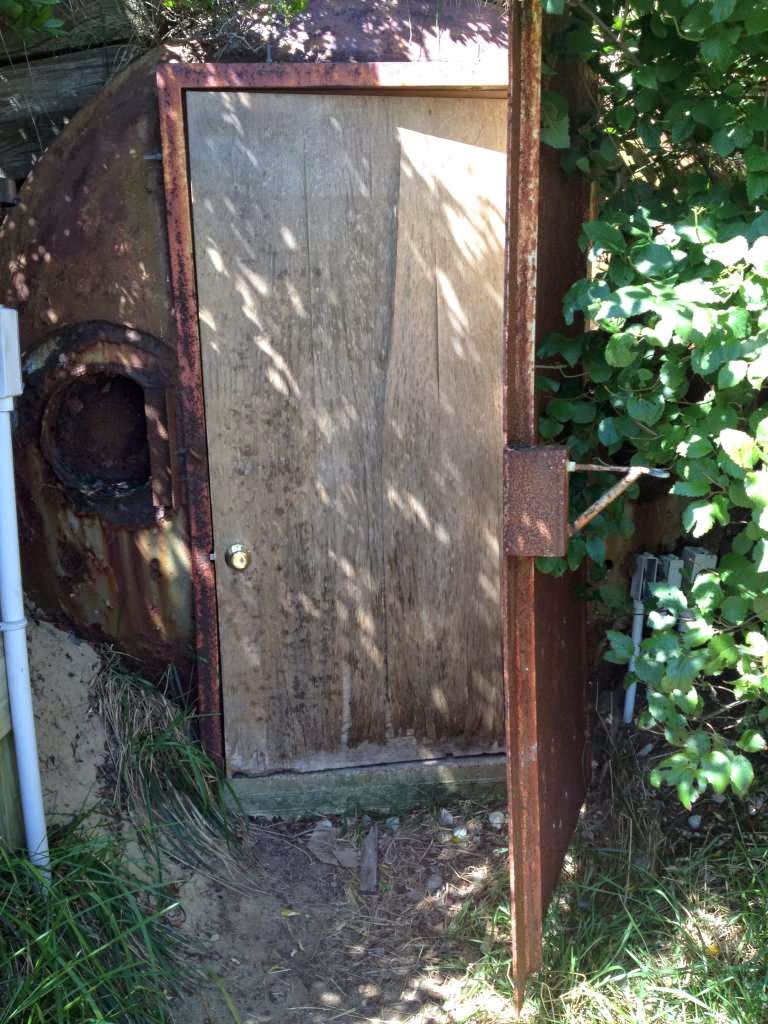
To the right of the rock, there is what is clearly an entrance to the bunker with a big old rusted steel door.


Maire Anne said "is the door unlocked?" Yeah, right, I thought. But when we looked at it,we saw no big padlock or chain.


I gave it a tug, and it swung right open and revealed...


...another door!


Maire Anne said, again, "is it locked?" I felt like I was in an old Carol Burnett episode. Amazingly, this door was unlocked as well. I opened it carefully, remembering quite acutely the time that a colleague of mine and I cracked open the door to a long-abandoned structure during a geophysical survey and were greeted by wasps. We opened the door to see... this. You can't tell from the pic, but the large corrugated metal tube is horizontal. That is, it goes straight into the mound, not down at an angle. Not a subterranean bunker, you understand; "bomb shelter" is probably the better word.


Wow, we both thought... this must be the place. What else could it be? Should we go in? Is this even legal? Curiosity is a powerful drug. With iPhone flashlight at the ready, in I went. Below is me looking back at Maire Anne, begging her not to lock me in. Hey, we've been married 30 years and love each other deeply, but you never know when someone harbors a grudge.


My iPhone flashlight was laughably inadequate, and when I tried to take pics, of course the flashlight cut out, and I was left standing in pitch blackness, fumbling to turn the flashlight app back on. But it clearly appeared that the bunker was made from intersecting corrugated metal tubular Quonset structures. Below are some absolutely awful photos:


Maire Anne came in and joined me, but with inadequate flashlights, and images of Island kids bragging "yeah, we locked ANOTHER pair of tourists inside, weren't they FUNNY when they SCREAMED," we didn't stay longer than a minute.

Then we climbed up on top of the bunker. Below are some pics from the top of the mound, showing the fairgrounds, playground and ballfield, and the gorgeous southern Nantucket coastline.


After we got back home, I searched again online for info on the Nantucket Kennedy Bunker. This time, I found this site, which misrepresents the location as Cuttyhunk Island, but clearly is the same facility. In the photos on this site, the lights are on, the facility is clean and well-lit, and you can clearly see what's murky and ill-illuminated in my bad cell phone pics.


I also found this piece in the New York Times. It is predominantly about the Peanut Island bunker (calling it "the worst-kept secret in Palm Beach"), but mentions the Nantucket bunker. Interestingly, it says that the site "has never been open to the public" -- ironic considering how "open" we found it.


Maire Anne and I wondered... was it by accident that it was open? Was it supposed to be locked but was recently broken into? Or is it such old news among island residents that the town feels the liability issues are of little concern? I'm curious about these things, and will make a few calls to the Town of Nantucket and the Nantucket Historical Society to find out.

I'm glad Maire Anne and I chose to spend our hour before the ferry departed in this way. Yes, we could have spent the hour a different way -- you know, joined the "bunker club" -- but, you know, after 30 years of marriage, the lure of comfort and clean sheets is pretty strong.

Besides, now we know what to bring next year. And, yes, the parallels are obvious, but only up to a point. I mean, I share JFK's appetites, but I'm a one-woman man. But if the world is ending, now we know where to go.

Or come.

:^)

(copyright 2014, Rob Siegel. all rights reserved.)

Sunday, August 11, 2013

Yellow Car! Meditations on the Value of Competitiveness

Maire Anne and I have been coming to Nantucket for nearly 30 years. Our kids have Nantucket vacation memories woven into the fabric of their lives. About 12 years ago my brother-in-law Dan and my nieces Aidan and Guthrie began joining us. This has been a gift, as it has provided an opportunity for Maire Anne to spend time with her brother (who has evolved into my fishing buddy), and for my boys to spend time with their cousins.

And for me to enjoy my nieces Aidan and Guthrie, both of whom I absolutely adore. In the chapter in my book titled "The Bluefish Races (or, wanna drive?)" I talk about the family tradition of using Nantucket's vehicularly-accessible beaches to give my kids, and my nieces, their first driving lesson. This has been a particularly special thing with Guthrie, who is the sort of kid who knew, to the day, when she was eligible for her permit and license, and bugged her parents until she had the paper.

Driving on the beach was less important to Aidan, but the two of us have had other traditions, and some of them have brought out a competitive streak in both of us. This is a surprise to me. I'm not by nature a competitive person. Most of the time I could give a shit about sports (I'm certain I'm the only person in New England who felt a certain perverse satisfaction when the Patriots lost the superbowl at the end of their otherwise perfect season). I remember doing a team-building exercise at work many years ago where everyone had to write down their personal values, then work together to come up with group values. My boss wrote "winning" as his #1 personal value. I thought, that one isn't even in my vocabulary, much less on my list, much less the topper of that list. And Aidan is a whip-smart Mount Holyoke student, laser-focused on certain key interests. I hadn't expected her personality to manifest itself in a stridently competitive way (although I suppose her presence on the fencing team might have tipped me off).

Although Aidan hasn't participated in the informal competition for our annual family Fish Trophy, for several years we've competed in other ways. For a while, during both vacation and Thanksgiving visits, we played Trivial Pursuits -- The Lord of the Rings Edition. It was here that I first saw the fierce take-no-prisoners nature of her competitive streak. I drew the question "What language did the Riders of Rohan speak?" I answered "Ronic." The card said "Rohirric." She wouldn't give it to me, even though she was totally and completely mopping the floor with me, game after game. Of course, this set the bar for subsequent TP disputes. After that, I didn't give her an inch. And she still clobbered me.

This vacation, Aidan introduced us to the game "Yellow Car." She explained that, originating in the British radio sitcom "Cabin Pressure," the game is elegant in its simplicity. It has but a single rule -- when you see a yellow car, you yell "yellow car!" As we began to play, we learned that, in fact, there is a second rule: Taxis don't count (this because, on the show, the character Arthur Shappey blurts out "yellow car!" every two seconds when he sees the surfeit of taxi cabs in London, so his brothers impose this rule to get him to shut up). A vacation guest of ours saw a school bus and yelled "yellow car!" Aidan said "school buses don't count -- only cars." Then the same question came up regarding a yellow van. I pointed out that most yellow cars we'd seen on Nantucket were a Jeep or other sport utility vehicle, and that these are classified as light trucks, thus technically not cars. She grudgingly let the point go.

But for the rest of vacation, she was relentless in being the first to yell "yellow car!" whenever we were driving somewhere and encountered a yellow car.

So I, of course, stepped up to the challenge. Game on, MoHo girl. Whenever I saw a yellow car and called it before she did, she said "damn it!" She contended that I had the advantage because I, the driver, could see out the front window better than she could being a passenger in the back seat. I said that, no, in fact, as a passenger she had the advantage because she could look down driveways and in parking lots, which she did with cruise missile-like targeting, including remembering specific locations where specific yellow cars were parked (I will admit that I began doing this as well).

Finally, as Dan and the girls' vacation stay was nearing an end, we drove them to the ferry. As we wended our way through Nantucket center and were about to turn onto the street leading to the Steamship Authority terminal, I spied a yellow car and said, with a certain aplomb, "yellow car, and oh, by the way, probably the LAST yellow car we'll see before the ferry." I smiled, thinking that I had gotten her.

This, of course, elicited a stiff "damn it!" from Aidan. She then went into full-on focused Terminator mode, feverishly scanning in all directions as we drove the last few hundred feet into the ferry parking lot. 

Then, with some degree of triumphalism, she yelled "YELLOW CAR!" Sure enough, there in the ferry parking lot was a lone yellow car. She smiled triumphantly. Oh well, I thought, too bad. 

But it ain't over 'till the fat ferry sings.

As they loaded their luggage onto the cart, and we hugged goodbye, and they began to walk toward the gang plank to take them up onto the ferry, I looked back in the direction of Nantucket center. There, perhaps a hundred yards up the street, could it be? Yes! I said slowly and loudly "Yellow. Car. BOOM!" and pointed up the street. It was a ways away, but it was unmistakable. It elicited a final "damn it!" from Aidan, indicating that it was unarguable. If I had a microphone, I would've dropped it and engendered the loud DOOF and feedback squeal, as comedian Chris Rock sometimes does at the end of an in-your-face performance.

I can't say Aidan was crestfallen, or furious. That would be an exaggeration. It is only a game. But she was NOT pleased. My family gave me grief. "How could you have taken that away from her?" they asked.

I've thought about this for a few days. I don't think I "took anything away" from my dear niece. I think I added to our relationship. This is playful, constructive interaction. I fully expect Aidan and I to begin texting each other pictures of yellow cars.

But is this a window into a higher value for competitiveness? I'm not sure I'd go that far.

That having been said, I must admit that my final, door-closing, game-ending, microphone-dropping, soul-crushing "yellow car" was a thing of beauty. Like the Star Trek Next Generation episode where Data has to admit that he enjoyed killing the Borg, I need to admit that, despite my Zen self-image, I apparently do have a competitive streak.

Or maybe it's just that my brilliant quirky niece brings the worst in me.

So. Go ahead. Introduce "yellow car" to your family. See who plays. See what it brings out. But be prepared to bring your A-game. Take no prisoners. Expect no quarter. For none will be given.